The Workforce Current | Issue #001 | By Michael Shue
Executive Summary
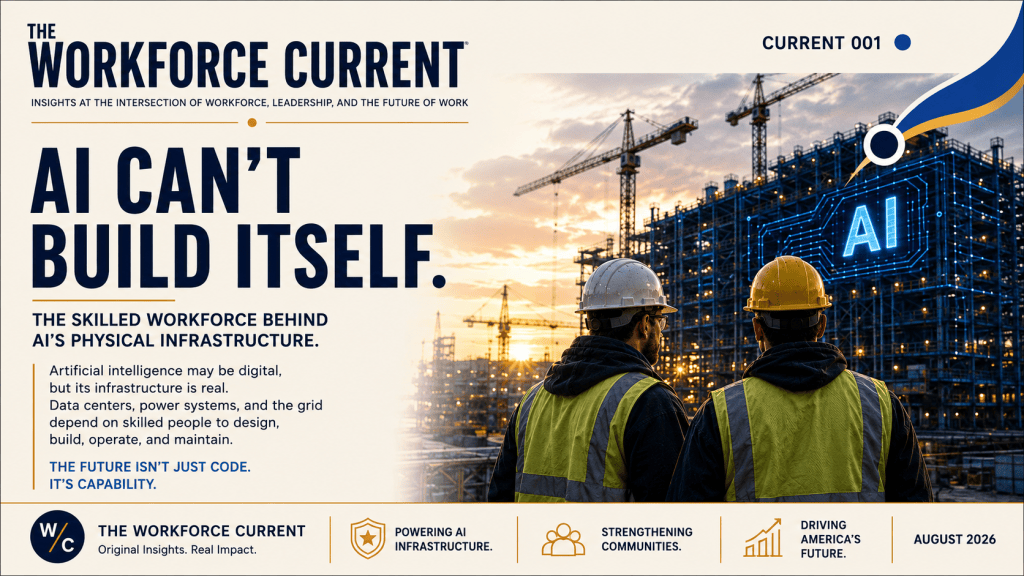
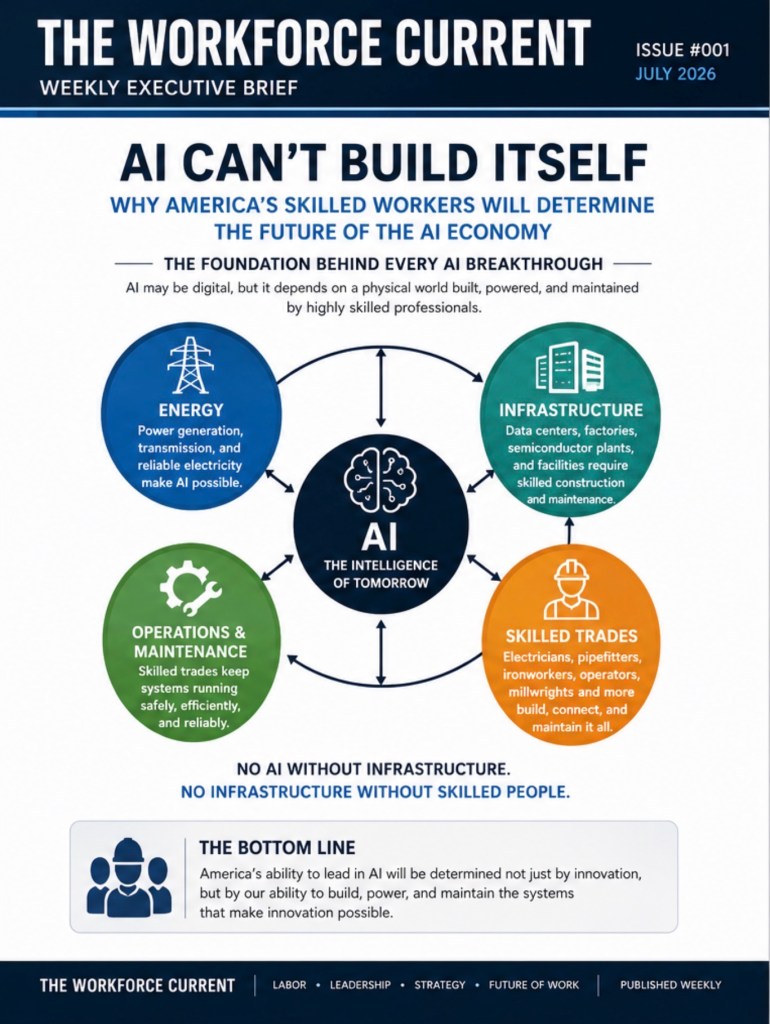
Artificial intelligence is transforming industries at an unprecedented pace. While public attention centers on breakthroughs in software, machine learning, and automation, a critical truth is often overlooked: AI cannot function without the physical infrastructure that supports it.
Every data center depends on reliable electricity. Every semiconductor facility requires complex construction and precision installation. Every transmission line, cooling system, industrial control network, and manufacturing plant relies on skilled professionals who design, build, operate, and maintain essential infrastructure.
America’s leadership in the AI economy will be determined not only by innovation—but by its ability to develop and sustain the workforce required to support that innovation.
Why This Matters
Across the country, organizations are making significant investments in AI, advanced manufacturing, grid modernization, and energy infrastructure. At the same time, they are competing for a limited and aging pool of experienced craft professionals.
This is no longer a routine hiring challenge. It is a strategic constraint that directly impacts project timelines, operational reliability, productivity, and long-term competitiveness.
Workforce development must be treated with the same level of executive focus as capital investment and technology strategy.
The Current Landscape
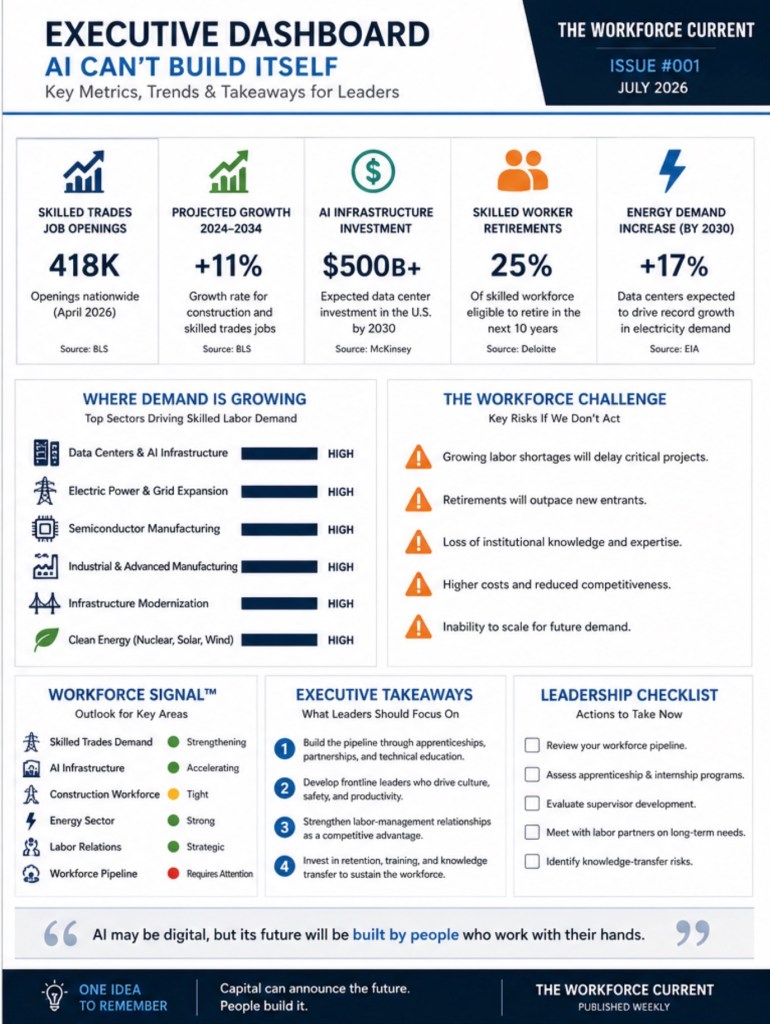
Demand for skilled labor continues to rise across multiple critical sectors, including:
● AI data center construction
● Electric generation and transmission
● Nuclear energy
● Semiconductor manufacturing
● Industrial maintenance
● Infrastructure modernization
● Advanced manufacturing
While technology continues to improve efficiency and productivity, it does not eliminate the need for highly trained professionals capable of safely building and maintaining complex industrial systems.
Executive Analysis
Organizations best positioned for long-term success will pursue three integrated priorities:
● Technology investment
● Workforce development
● Strong labor-management relationships
These are not competing priorities—they are mutually reinforcing pillars of execution.
Companies that treat skilled trades and workforce strategy as core strategic assets will be better equipped to deliver large-scale projects, maintain operational continuity, and respond to evolving market demands.
Looking Ahead
Over the next decade, investment in Al and advanced infrastructure will continue to accelerate. However, success will increasingly depend on organizations that can build, train, and retain the workforce required to support expanding energy, manufacturing, and digital infrastructure systems.
Technology may be digital, but its future remains fundamentally physical.
The future of artificial intelligence will not be shaped solely by software engineers or algorithms.
Closing Perspective
It will also be built by electricians, pipefitters, boilermakers, ironworkers, laborers, millwrights, carpenters, operating engineers, technicians, and the many skilled professionals who construct, power, and maintain the systems that make innovation possible.
America’s competitive advantage will ultimately be built by the people who build America.
The Workforce Current Principle™
Al cannot build itself. Every technological breakthrough ultimately depends on skilled people.
About The Workforce Current
The Workforce Current is a weekly executive publication exploring labor relations, workforce strategy, skilled trades, energy, leadership, artificial intelligence, and the future of work.
Follow Michael Shue and subscribe to The Workforce Current for future issues.
Next Issue
Trust Is the Real Collective Bargaining Agreement – Why the strongest labor-management partnerships are built between negotiations.
The views expressed are my own and do not necessarily reflect the views of my employer or any organization with which I am affiliated.
