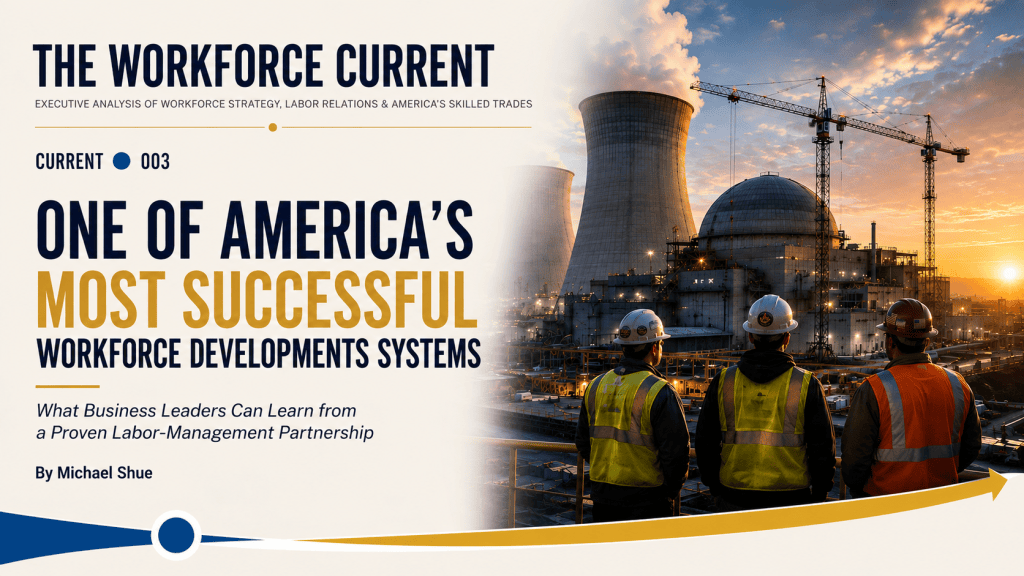
What Business Leaders Can Learn from a Proven Labor-Management Partnership
The Workforce Current |By Michael Shue | Current 003
Executive Brief
Nearly every discussion about America’s workforce arrives at the same conclusion.
America has a skilled labor shortage.
Executives ask where the next generation of skilled professionals will come from. Policymakers debate new workforce initiatives. Industry associations call for additional investment. Headlines warn that infrastructure, manufacturing, energy, semiconductor, artificial intelligence, and data center projects may be delayed because there simply are not enough skilled craft professionals.
Those concerns are legitimate.
But they also raise a more important question.
What workforce development systems have consistently produced highly skilled professionals over generations—and what can business leaders learn from them?
America benefits from multiple workforce development models, each contributing to the preparation of skilled professionals. Among them, the Building Trades labor-management apprenticeship system stands apart for its scale, sustained private investment, longevity, and demonstrated results.
For decades, this partnership has quietly demonstrated a simple truth:
Workforce development is not simply a hiring strategy. It is a long-term business strategy.
As America accelerates investment in artificial intelligence, advanced manufacturing, nuclear energy, semiconductor fabrication, data centers, and grid modernization, the leadership lessons from this model extend far beyond the construction industry.
A Leadership Moment
Imagine your board has approved a $5 billion data center campus.
Financing has been secured.
Permits have been approved.
Major equipment has been ordered.
Customers are waiting.
Then one question suddenly becomes more important than every engineering drawing or financial projection.
Who will build it?
At that moment, workforce development is no longer an HR initiative.
It becomes a strategic business issue.
Success depends not simply on finding enough workers, but on having access to professionals whose capabilities have been developed through years of structured training, nationally recognized qualifications, mentoring, and real-world experience.
Organizations that intentionally build—or partner with—those workforce systems position themselves to execute strategy faster and more reliably than organizations that wait until labor shortages become immediate business problems.
A Case Study in Long-Term Workforce Strategy
Business leaders do not have to imagine what a mature workforce development system looks like.
One already exists.
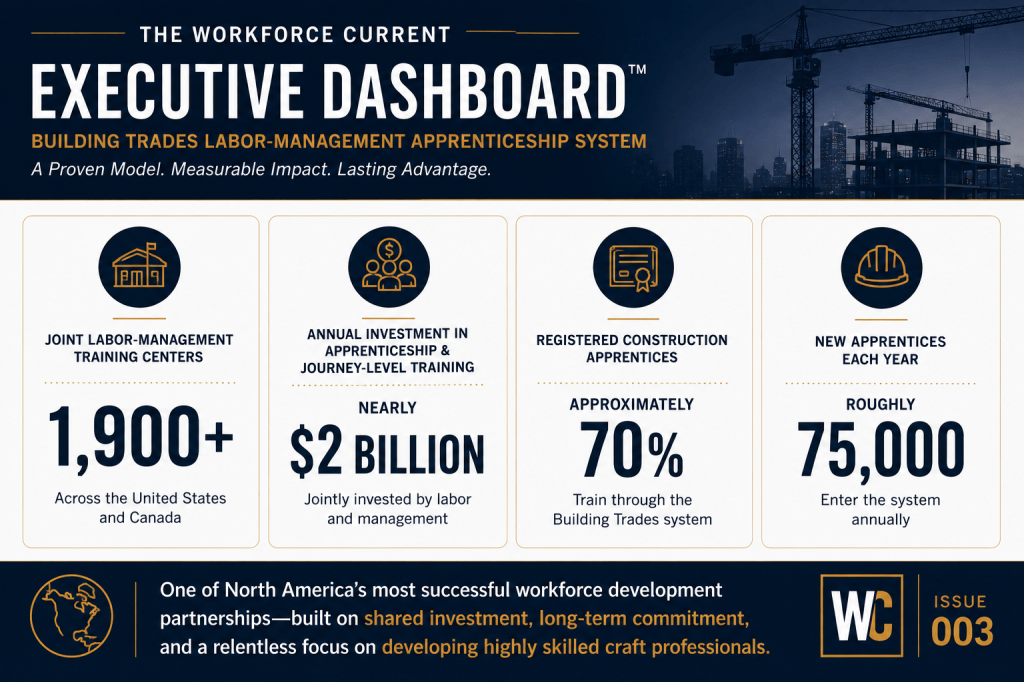
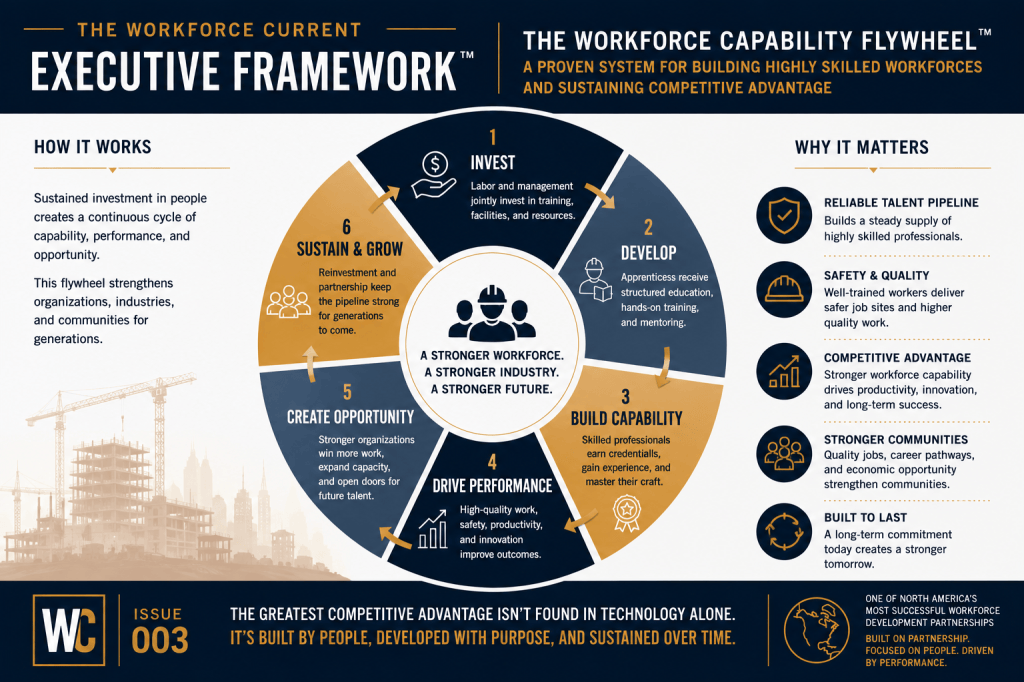
For generations, the Building Trades labor-management apprenticeship system has continuously invested in developing highly skilled craft professionals rather than reacting to labor shortages after they occur.
Building Trades professionals—including electricians, pipefitters, boilermakers, ironworkers, millwrights, operating engineers, carpenters, laborers, and many other crafts—construct and maintain the infrastructure that powers modern life.
At the heart of the system is a simple philosophy:
Develop capability before demand arrives.
Rather than depending primarily on hiring experienced workers, labor organizations and signatory contractors jointly invest in apprenticeships, classroom instruction, hands-on learning, mentoring, safety, and continuing education.
The result is more than a trained workforce.
It is a sustainable talent development system.
Measured by its scale, private investment, longevity, and sustained ability to develop highly skilled craft professionals, it represents one of North America’s most successful workforce development partnerships.
Why This Model Has Endured
Scale alone does not explain the partnership’s success.
No workforce development system remains successful for decades by accident.
Several characteristics help explain why this partnership has remained effective across generations.
Shares Ownership – Labor and management jointly invest in workforce development, creating mutual accountability for quality, safety, productivity, and long-term capability.
Long-Term Commitment – Training is treated as essential infrastructure rather than a discretionary expense that expands and contracts with economic cycles.
Continuous Modernization – Training evolves alongside changing technology so workers remain prepared for increasingly sophisticated industrial projects.
These characteristics are not exclusive to unionized organizations.
They are leadership principles.
Organizations of every size—and every workforce model—can adapt them.
Four Leadership Principles Every Executive Can Apply
Whether an organization is unionized or nonunion, four practical lessons emerge.
Think in Decades—Not Quarters
Strong workforce pipelines are built years before labor shortages become business problems.
Treat Workforce Development as Strategic Infrastructure
Organizations routinely invest billions in equipment, technology, and facilities because those investments create future capacity.
Developing people deserves the same strategic discipline.
Create Shared Ownership
The strongest workforce systems align the interests of everyone responsible for developing talent.
Develop Capability Before Demand Arrives
Organizations that consistently invest in people are better positioned when growth opportunities emerge.
Why It Matters Now
America’s fastest-growing industries—AI infrastructure, data centers, advanced manufacturing, semiconductor fabrication, nuclear energy, battery production, electric transmission, and grid modernization—all depend on highly skilled craft professionals.
Technology will continue to evolve.
The need for exceptionally skilled people will not.
Like every workforce development model, the Building Trades apprenticeship system faces important challenges, including recruiting the next generation of skilled professionals, responding to demographic shifts, addressing regional labor shortages, and continually adapting training for emerging technologies.
Recognizing those challenges strengthens—not weakens—the broader lesson.
Great workforce systems are never complete.
They require continuous investment.
Executive Takeaway
Executives frequently ask where tomorrow’s workforce will come from.
A better question may be:
Who is building the workforce systems that will produce tomorrow’s workforce?
There is no single solution to America’s workforce challenge.
Different industries will continue to rely on different approaches.
Yet when evaluated by sustained private investment, industry partnership, scale, longevity, and the consistent development of highly skilled professionals over generations, the Building Trades labor-management apprenticeship system stands among the most successful workforce development models in North America.
Its greatest lesson is not that every organization should become unionized.
Its greatest lesson is that exceptional organizations do not simply compete for talent.
They intentionally build it.
Markets evolve.
Technology advances.
Competitive advantage belongs to organizations that invest in people long before opportunity arrives.
That principle applies regardless of industry, workforce model, or organizational structure.
About
The Workforce Current
The Workforce Current explores leadership, labor relations, workforce strategy, skilled trades, energy, manufacturing, and the future of work. Each issue examines practical leadership ideas that help organizations strengthen organizational performance and the people who make that performance possible.
Looking Ahead
Issue #004
The Skilled Trades Image Problem
America’s workforce challenge isn’t just about building a larger pipeline.
It’s also about changing perceptions.
Building the next generation of skilled professionals will require industry, educators, families, employers, and policymakers to rethink how skilled trades careers are presented, understood, and valued.
Editorial Disclaimer
The views expressed in The Workforce Current are my own and are intended to encourage thoughtful discussion about leadership, workforce strategy, labor relations, and the future of work. They do not necessarily represent the views of my employer or any organization with which I am affiliated.
