The Workforce Current | By Michael Shue | Current 002
Executive Brief
Most leaders spend months preparing for collective bargaining. They analyze data, develop proposals, anticipate questions, and rehearse strategy.
Yet one of the most important factors influencing the outcome of negotiations is rarely found in a briefing book.
It’s the quality of the relationship that existed before anyone entered the room.
Contracts establish expectations. Trust determines whether those expectations become productive partnerships.
In an era shaped by workforce shortages, technological change, and increasing operational complexity, organizations that intentionally build trust between negotiations will almost always be better positioned to navigate the negotiations themselves.
A Leadership Moment
Imagine walking into the first day of contract negotiations.
The agenda is familiar. The issues are significant. Both sides understand that difficult conversations lie ahead.
Now imagine two different rooms.
In the first, every statement is questioned. Every proposal is viewed with suspicion. Past disagreements dominate the discussion before a single new issue is raised.
In the second, the conversations are no less difficult, but there is a foundation of credibility. The participants know they may disagree, but they also know each side will communicate honestly, follow through on commitments, and work toward practical solutions.
The contract may ultimately contain similar language in both cases.
The experience, and often the outcome, will be dramatically different.
The strongest labor agreements don’t begin at the bargaining table. They begin in yesterday’s conversations.
That’s why trust should be viewed as a strategic capability, not simply an interpersonal virtue.
Why This Matters
Organizations today face a convergence of pressures unlike any in recent memory.
- Experienced employees are retiring at historic rates.
- Skilled labor shortages continue across critical industries.
- Artificial intelligence is reshaping how work is planned and executed.
- New generations are entering the workforce with different expectations about leadership and communication.
At the same time, organizations are being asked to deliver greater reliability, productivity, and innovation.
Under these conditions, labor-management relationships become more than an employee relations function.
They become a strategic business capability.
Research across employee engagement, organizational trust, and leadership effectiveness consistently points in the same direction: organizations with stronger communication, greater credibility, and more engaged leadership are generally better equipped to adapt, perform, and sustain workforce commitment.
Trust is not a “soft skill.”
It is organizational infrastructure.
Like physical infrastructure, its value is often invisible, until it fails.
Leadership Perspective
During more than three decades working in industrial operations and labor relations, one lesson has remained remarkably consistent.
The organizations that navigate difficult situations most effectively are rarely the ones with the most sophisticated contract language.
They are the ones that invested in relationships long before conflict emerged.
Contracts establish boundaries.
Leadership determines what happens inside them.
Every conversation…
Every grievance meeting…
Every plant walkdown…
Every coaching discussion…
Every difficult decision…
Either strengthens credibility or weakens it.
Leadership earns credibility long before it asks for trust.
The Partnership Pyramid
One observation has become increasingly clear throughout my career.
Healthy labor-management relationships are built progressively—not instantaneously.
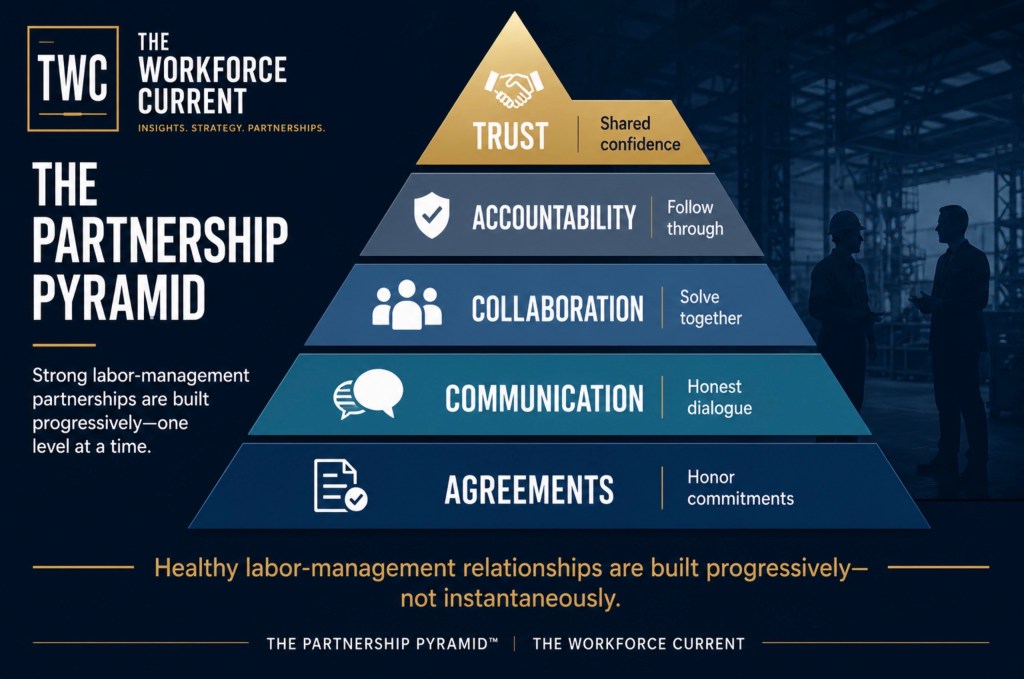
Each level depends upon the one below it.
Organizations cannot expect trust without accountability.
Accountability cannot exist without collaboration.
Collaboration depends upon communication.
And communication becomes far more productive when both parties consistently honor the commitments established in their agreements.
Many organizations spend enormous resources preparing for negotiations.
Far fewer invest intentionally in strengthening the levels beneath trust every day between negotiations.
That may be one of the greatest untapped opportunities in labor relations.
Five Leadership Practices That Strengthen the Pyramid
1. Listen Before You Lead
People are more willing to support decisions when they believe they have first been heard.
Listening is not agreement.
Listening communicates respect.
2. Explain the “Why”
Employees often accept difficult decisions more readily when leaders provide context rather than simply direction.
Transparency reduces unnecessary speculation.
3. Address Small Problems Early
Unresolved issues rarely become easier with time.
Every grievance teaches something. Great organizations learn the lesson before the next one arrives.
4. Be Predictably Consistent
Fairness builds confidence.
Consistency builds credibility.
Credibility builds trust.
5. Invest Between Negotiations
Organizations frequently devote months preparing for bargaining.
The strongest organizations spend years preparing relationships.
Leadership Reflection
Before your next labor-management meeting, consider asking yourself:
- If negotiations began tomorrow, what level of trust already exists?
- Have I invested in relationships outside formal bargaining?
- Would employees describe my leadership as consistent?
- Do people understand not only what decisions were made, but why?
- What small issue should we address today before it becomes tomorrow’s major conflict?
The Road Ahead
Artificial intelligence will continue to reshape work.
Technology will continue to accelerate change.
Demographics will continue to transform the workforce.
Yet one principle is unlikely to change.
Organizations move faster when trust moves first.
The future of labor relations will not be determined solely by stronger contracts.
It will be determined by stronger relationships.
Because while agreements establish the rules of engagement…
Trust determines whether people choose to engage at all.
Closing Reflection
The most successful labor-management partnerships are not defined by the absence of disagreement.
They are defined by the presence of mutual credibility.
Every conversation is either making the next negotiation easier, or harder.
Every decision either strengthens credibility, or weakens it.
Every day between contracts shapes the success of the next one.
The choice is made long before either side sits down at the bargaining table.
The Workforce Current Principle
Trust is not the reward for successful negotiations. It is the foundation that makes successful negotiations possible.
About The Workforce Current
The Workforce Current is a weekly executive publication exploring labor relations, workforce strategy, leadership, skilled trades, artificial intelligence, energy, manufacturing, and the future of work.
Each issue provides practical insights, original leadership frameworks, and executive perspectives designed to help leaders build stronger organizations and stronger workforce partnerships.
Follow Michael Shue and subscribe to The Workforce Current for future editions.
Looking Ahead
Issue #003
Great Supervisors Don’t Just Manage Work—They Shape Workplace Culture
A supervisor’s daily decisions influence engagement, trust, safety, performance, and labor relations long before formal leadership strategies take effect. The next issue explores why frontline leadership remains one of the most underappreciated competitive advantages in modern organizations.
Editorial Disclaimer
The views and opinions expressed in this publication are my own and do not necessarily reflect the views of my employer or any organization with which I am affiliated. This publication is intended to encourage professional discussion and does not constitute legal, labor relations, or employment advice.
