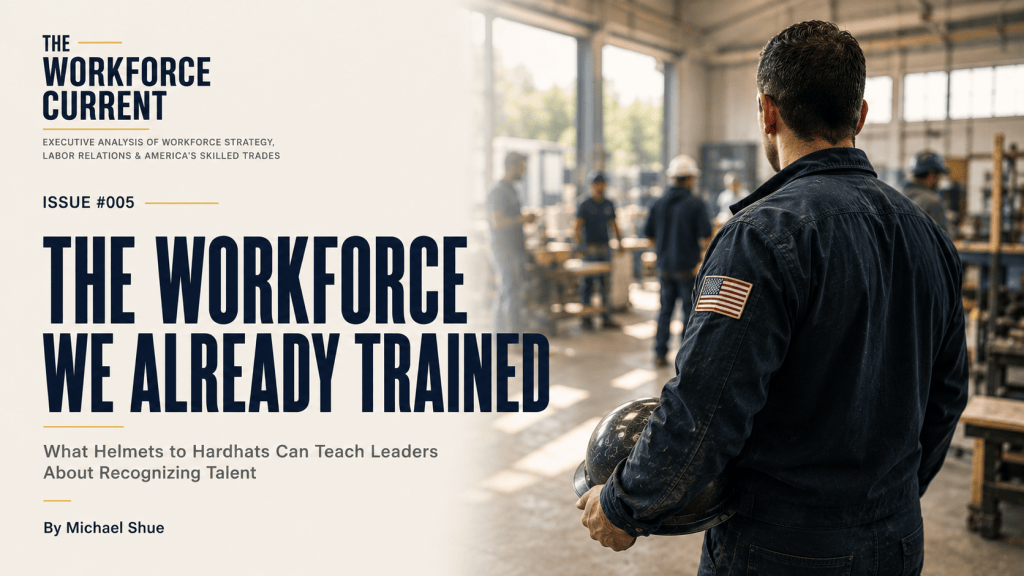
What Helmets to Hardhats Can Teach Leaders About Recognizing Talent
THE WORKFORCE CURRENT | By Michael Shue | Current 005
EXECUTIVE BRIEF
America’s workforce shortage is usually framed as a supply problem.
We need more people.
More electricians. More technicians. More skilled professionals.
But what if part of the shortage isn’t simply about how many people are available?
What if it is also about which people employers have learned to recognize?
Military veterans offer a powerful example.
Service members can spend years operating in environments that demand preparation, accountability, adaptability, teamwork, technical learning, and execution under pressure.
Then they enter the civilian workforce carrying experience that does not always translate neatly onto a resume or job application.
The capability is there.
The recognition may not be.
Helmets to Hardhats has spent more than two decades working across that divide—helping veterans translate military experience into opportunities in the skilled trades.
But the larger lesson extends well beyond veteran employment.
If employers continue searching for talent only where they have always found it, they may continue overlooking capable people who are already here.
THE EXECUTIVE SIGNAL™
The Talent Shortage May Also Be a Translation Problem
Civilian hiring systems are generally built around recognizable signals.
Degrees.
Certifications.
Job titles.
Years of directly related experience.
Those signals are useful.
But they can also create blind spots.
Consider someone leaving military service.
Their previous job title may have no obvious civilian equivalent. Their leadership experience may have occurred in an environment unfamiliar to a corporate recruiter. Their technical training may not perfectly align with a civilian job description.
Yet beneath those differences may be precisely the characteristics employers say they struggle to find:
Preparation.
Punctuality.
Accountability.
Adaptability.
Problem-solving.
The ability to learn.
Martin F. Helms, Executive Director of Helmets to Hardhats, believes employers sometimes underestimate those characteristics when evaluating veterans.
“Give the veteran a chance to prove themselves, and the outcomes may surprise the employer.”
That raises a larger question for workforce leaders:
Are we screening for capability—or familiarity?
WHAT EMPLOYERS MAY BE MISSING
When I asked Helms what employers discover after hiring veterans that they may not have fully appreciated beforehand, he didn’t begin with technical skills.
He talked about mindset.
Military environments create repeated exposure to changing conditions, difficult assignments, team dependence, and responsibility for accomplishing a mission.
Helms described the resulting mindset simply:
“Veterans tend to be problem solvers rather than excuse-makers.”
That distinction matters.
Ask executives what they want from their workforce and the same characteristics appear repeatedly:
Initiative.
Ownership.
Resilience.
Accountability.
Problem-solving.
Leadership.
Yet organizations often try to identify those characteristics by searching for candidates who have already performed essentially the same civilian job somewhere else.
That is understandable.
It also narrows the talent pool.
The question is not whether every veteran is suited for every position.
They aren’t.
Neither is every college graduate, apprentice, experienced hire, or internal candidate.
The more important question is whether organizations can distinguish between experience doing the job and capacity to become exceptional at the job.
Those are not always the same thing.
A LEADERSHIP STORY
Helms has seen that distinction personally.
During his military service, he supervised soldiers whose characteristics convinced him they could succeed in the electrical trade.
He encouraged them to investigate the skilled trades and Helmets to Hardhats when they returned home.
They did.
Today, Helms says, they are electricians serving in leadership roles.
One story remains particularly meaningful to him.
A decorated Marine had completed five deployments, four involving combat. Only later did Helms understand more fully what the Marine had experienced, including the loss of people close to him.
The Marine eventually told Helms that being encouraged toward the trades had helped him regain something important:
A sense of purpose and mission.
There is a workforce lesson inside that story.
Compensation matters. Benefits matter. Training matters.
But people also want to believe their work has consequence.
For someone leaving an institution built around mission, team, responsibility, and identity, employment alone may not recreate that connection.
Meaningful work can.
Helms described what many transitioning service members are looking for this way:
“Service members seek genuine opportunities and trust, not empty promises or indifference.”
That is not merely a veteran-retention lesson.
It is a leadership lesson.
THE EXECUTIVE ANALYSIS
Stop Hiring Only for the Past
Most hiring systems answer a backward-looking question:
What has this person already done?
Workforce strategy requires another:
What is this person capable of becoming?
That distinction becomes increasingly important as technology, infrastructure investment, demographic change, and retirements alter skill requirements faster than traditional pipelines can replenish them.
Employers should not lower standards.
They should become more precise about what those standards actually measure.
A particular civilian job title may be useful.
Accountability may be more important.
Industry experience may be useful.
Learning agility may be more important.
An exact technical match may shorten initial training.
Problem-solving ability may create greater long-term value.
Helmets to Hardhats illustrates the opportunity.
On one side is a population carrying experience, discipline, training, and leadership developed through military service.
On the other are industries that need people capable of learning complex work, functioning within teams, accepting responsibility, and developing technical expertise.
Between them sits a gap:
Recognition.
Strong workforce systems bridge that gap.
They help employers recognize potential, candidates translate experience, and structured development turn potential into proficiency.
For the skilled trades, apprenticeship can provide that bridge.
A veteran does not need to arrive as an electrician, pipefitter, ironworker, operating engineer, or other skilled professional.
The individual needs the capacity to become one.
Structured training develops the rest.
Organizations that understand that distinction can expand their talent pipelines without lowering the bar.
They may actually raise it.
THE LEADERSHIP LESSON
When I asked Helms what advice he would give CEOs and senior executives facing workforce shortages, his answer moved beyond recruiting.
It moved to leadership.
He described a military leadership philosophy built around responsibility for the people entrusted to you.
Leaders establish expectations.
They provide resources.
They develop their people.
They assign responsibility.
Then they trust people to execute within that responsibility.
Helms calls it unselfish leadership.
The opposite exists in many organizations.
Managers receive accountability without meaningful authority. Decisions move upward. Initiative slows.
Employees learn that acting carries more organizational risk than waiting.
Eventually, the workforce becomes dependent on hierarchy rather than capable of operating through it.
Helms believes veterans can bring another model into organizations—one where leadership means creating the conditions for other people to succeed.
For executives, that may be the more important Helmets to Hardhats lesson.
Veterans are not simply another source of labor.
They may also carry leadership behaviors organizations are trying to build.
EXECUTIVE FRAMEWORK™
RECOGNIZE → TRANSLATE → DEVELOP → TRUST
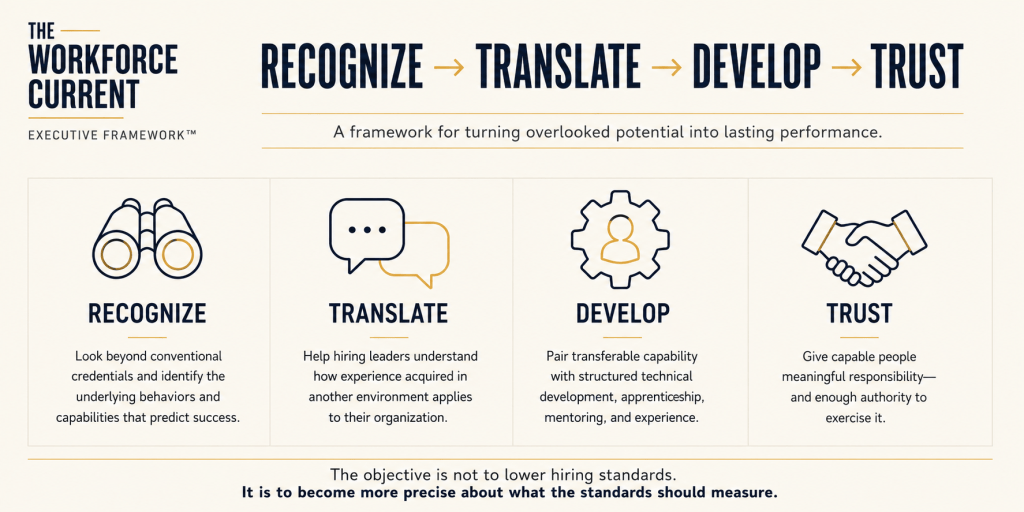
01 — RECOGNIZE
Look beyond conventional credentials and identify the underlying behaviors and capabilities that predict success.
02 — TRANSLATE
Help hiring leaders understand how experience acquired in another environment applies to their organization.
03 — DEVELOP
Pair transferable capability with structured technical development, apprenticeship, mentoring, and experience.
04 — TRUST
Give capable people meaningful responsibility—and enough authority to exercise it.
The objective is not to lower hiring standards.
It is to become more precise about what the standards should measure.
LOOKING AHEAD
America has faced the challenge of translating military capability into civilian opportunity before.
After World War II, millions of returning service members reentered civilian life during a period of significant American economic and industrial expansion.
The circumstances today are different.
But the underlying opportunity is familiar.
Artificial intelligence may be digital. The infrastructure supporting it is not.
Energy systems, manufacturing facilities, transportation networks, data centers, and other physical assets still have to be built, operated, maintained, and modernized by people.
At the same time, men and women continue to leave military service carrying years of experience the civilian economy has an opportunity to use.
Veterans alone will not solve America’s skilled-workforce challenge.
But allowing capable people to remain underutilized while employers simultaneously report difficulty finding talent represents a workforce failure we should be capable of fixing.
That responsibility extends across employers, workforce organizations, labor, government, educators, and leaders responsible for building America’s next generation of talent.
CLOSING PRINCIPLE
THE WORKFORCE WE NEED
MAY ALREADY BE HERE.
Leadership begins by recognizing capability others overlook.
ABOUT THE WORKFORCE CURRENT
The Workforce Current provides weekly executive analysis at the intersection of labor relations, workforce strategy, leadership, and America’s skilled trades.
Each issue examines a workforce challenge, leadership principle, or labor-management practice shaping the future of work.
COMING NEXT
Issue #006 will examine another emerging workforce challenge and what it means for leaders responsible for building the workforce of the future.
The views expressed in The Workforce Current are those of the author and are provided for informational and educational purposes. They do not represent the views of any employer, organization, or affiliated entity.
