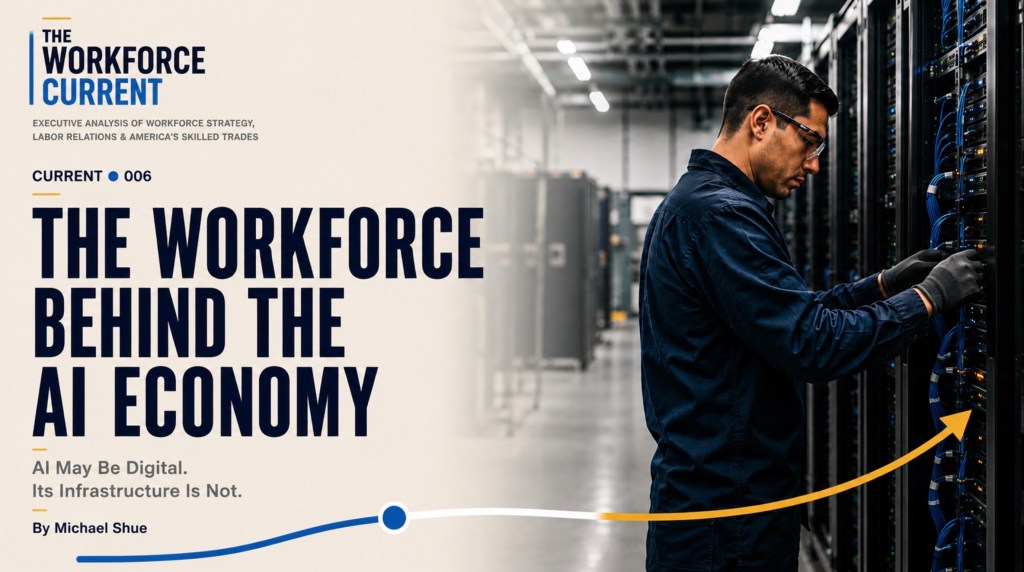
AI May Be Digital. Its Infrastructure Is Not.
THE WORKFORCE CURRENT | By Michael Shue | CURRENT ● 006
Executive Brief
Every prompt sent to an artificial intelligence model eventually becomes a physical event. Somewhere, processors run. Electricity flows. Heat is removed. Networks transmit data. Equipment operates.
Behind those systems are people.
Artificial intelligence is usually discussed through models, chips, software, and data. But its expansion reveals something larger:
AI is not merely creating a digital economy. It is expanding an infrastructure economy.
Computing requires data centers. Data centers require electricity, cooling, and sophisticated electrical and mechanical systems. Those systems require equipment, construction, commissioning, operations, and maintenance.
Each layer depends on another.
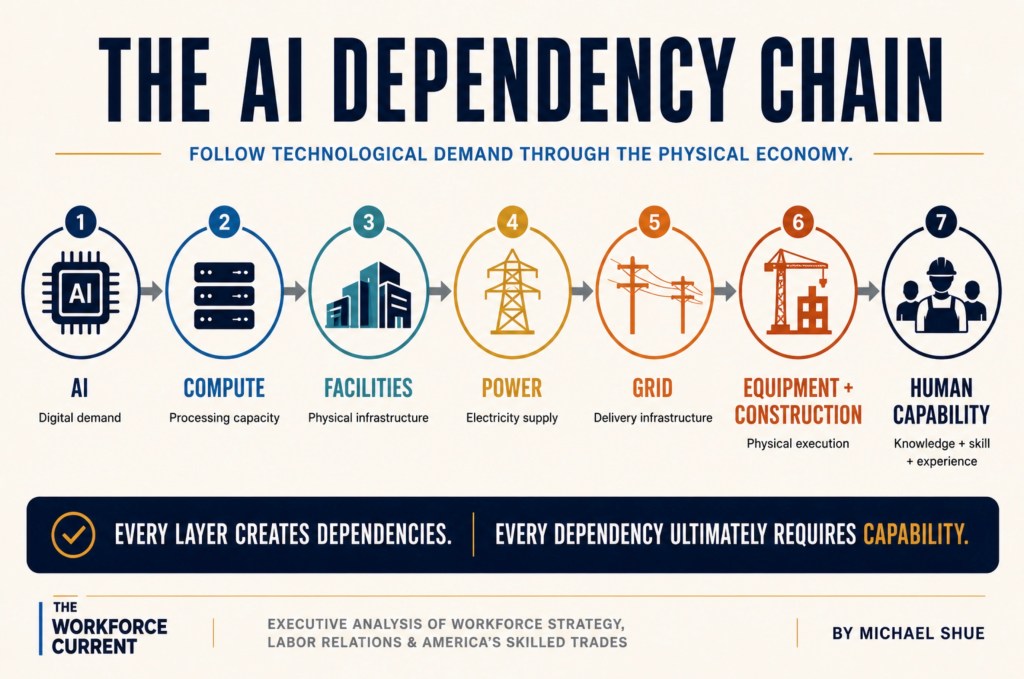
Understanding the workforce behind AI requires following that dependency chain.
The Hidden Architecture of AI
An AI model may exist in software. The system supporting it does not.
AI → COMPUTE → FACILITIES → POWER → GRID → EQUIPMENT + CONSTRUCTION → HUMAN CAPABILITY
Behind this system are engineers, technicians, skilled craft professionals, operators, supervisors, and project leaders whose work rarely appears in conversations about artificial intelligence.
This is the hidden workforce architecture of AI.
The digital economy depends on the physical economy—and the people capable of building and operating it.
By the Numbers
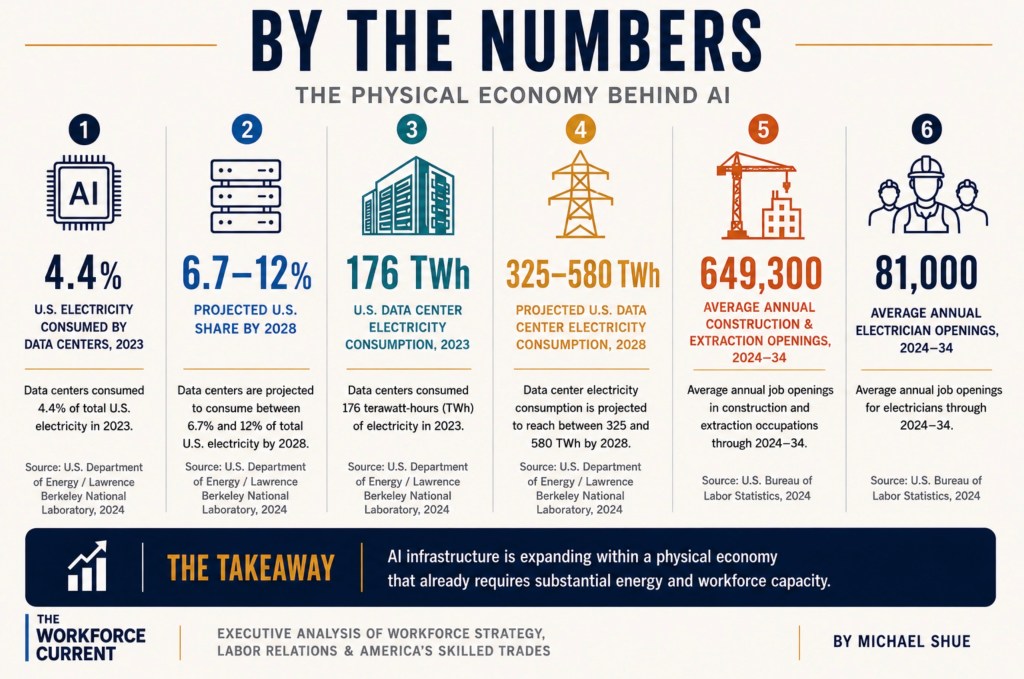
The physical footprint is already significant.
4.4% — Share of total U.S. electricity consumed by data centers in 2023
6.7%–12% — Projected share by 2028
176 TWh — U.S. data-center electricity consumption in 2023
325–580 TWh — Projected range by 2028
649,300 — Average annual openings projected across construction and extraction occupations through 2034
81,000 — Average annual openings projected for electricians through 2034
Sources: U.S. Department of Energy; U.S. Bureau of Labor Statistics, Construction and Extraction Occupations; U.S. Bureau of Labor Statistics, Electricians
These figures are not measures of AI-specific labor demand. They illustrate a broader expansion of computing infrastructure requirements.
THE EXECUTIVE SIGNAL™
Follow the Dependency Chain
The economic consequences of major technologies rarely remain inside the industries that created them.
AI is no exception.
Investment at one point in the dependency chain can create demand throughout the system.
AI’s economic footprint can therefore extend far beyond technology companies and semiconductor manufacturers—to utilities, power producers, equipment manufacturers, engineering firms, contractors, training institutions, and communities.
Executives should ask:
What will AI do to our business?
Where does AI-driven investment create demand elsewhere in the system?
The second question may reveal opportunities the first misses.
The Human Layer
At the bottom of nearly every infrastructure dependency sits human capability.
Not simply headcount—capability:
• Engineering complex systems
• Installing and commissioning correctly
• Operating safely and reliably
• Diagnosing and maintaining equipment
• Coordinating work and exercising judgment
These capabilities develop through universities, technical education, apprenticeships, employer training, mentorship, and experience.
Even the most advanced technologies still depend on humanity’s oldest method of expertise transfer: learning from people who already know how to do the work.
Look Beyond Automation
While the AI workforce conversation often focuses on substitution—jobs disappearing, tasks automated—it only shows one side.
AI expansion also creates demand:
More computing → More infrastructure
More infrastructure → More electricity
More electricity → Investment in generation and transmission
Those investments → Activity across engineering, manufacturing, construction, and maintenance
Technology doesn’t just eliminate work. It redistributes economic activity.
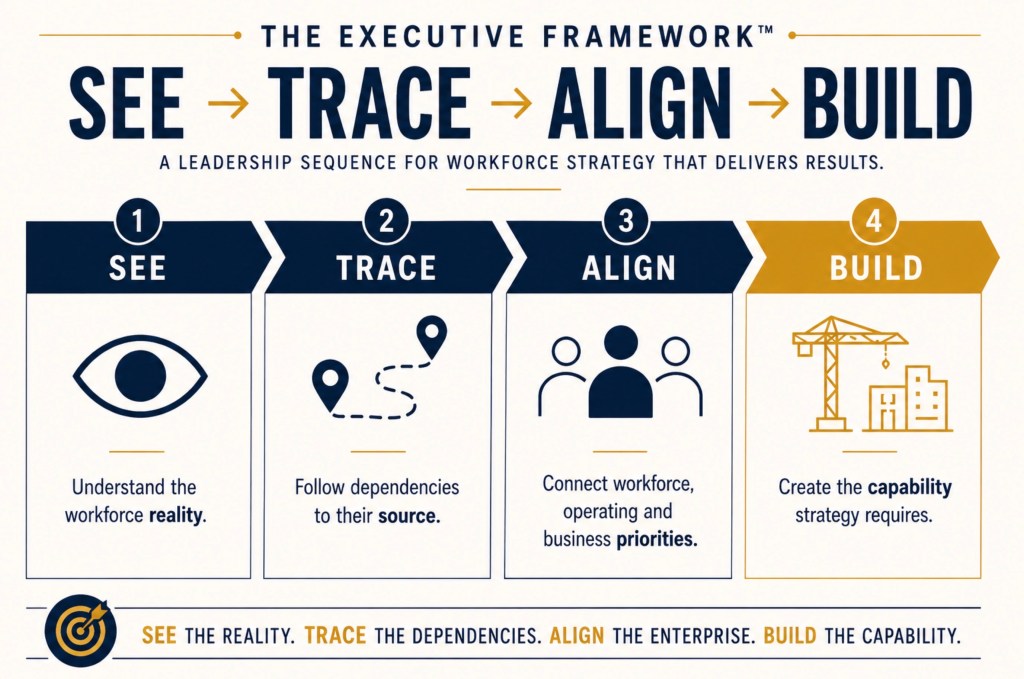
Executive Framework™
SEE → TRACE → ALIGN → BUILD
SEE — Look beyond the technology to its supporting physical systems
TRACE — Follow the dependency chain from computing to workforce
ALIGN — Connect investment with institutions developing human capability
BUILD — Convert technological ambition into safe, reliable operating assets
Leaders cannot prepare for dependencies they do not see.
Executive Takeaway
Artificial intelligence may transform how work is performed and organizations operate.
Its expansion requires a physical economy:
• Computing capacity must be housed
• Electricity must be generated and delivered
• Equipment must be manufactured
• Infrastructure must be constructed and maintained
• People must be able to operate it all
AI may change what work humans perform. But humans must still build and operate the economy AI requires.
THE DIGITAL ECONOMY STILL HAS TO BE BUILT.
NEXT CURRENT ● 007
THE CAPACITY TO BUILD
Capital can fund expansion. Technology can accelerate it. Demand can justify it.
But what happens when the limiting factor is the capacity to actually build?
Coming next in The Workforce Current.
The Workforce Current reflects the independent views and analysis of Michael Shue. It is not affiliated with, sponsored by, or representative of his employer or any other organization.
