
The tension between stability and necessary change.
The Workforce Current | By Michael Shue | Current 014
A labor agreement is designed to create stability.
It turns negotiated understandings into durable commitments. Employees gain protection against arbitrary change. Employers gain a defined framework for managing the work.
But the agreement remains in place while the workplace changes.
Technology evolves. Equipment changes. Staffing needs shift. New investments require new skills. Assumptions that made sense at the bargaining table may no longer fit the operating environment.
The question is not whether change will occur.
It will.
Central Question
How can the parties adapt without weakening the commitments that give the agreement credibility?
That is more than a contractual question.
It is a test of the labor-management system surrounding the contract.
STABILITY IS NOT RIGIDITY
Labor agreements should not change whenever circumstances become inconvenient. That would defeat their purpose.
Employees and unions need confidence that negotiated protections will endure. Managers and employers need predictable rules within which they can operate.
Those boundaries matter.
But stability and rigidity are not the same.
Stability creates confidence in how the system works. Rigidity assumes the system will never encounter something new.
No bargaining team can anticipate every technology, workforce shortage, operating condition, or disruption that may arise during the life of an agreement.
More detailed language can resolve known issues, but it cannot eliminate uncertainty.
The 2023 Writers Guild of America strike shows how quickly that uncertainty can arrive. The guild’s agreement with the major studios, in effect since 2020, was negotiated before generative AI tools such as ChatGPT reached the public. When writers proposed rules for its use, the studios countered with annual meetings to discuss advancements in technology. AI became one of the central issues in a 148-day strike. The next agreement established that AI-generated writing does not count as literary material under the contract and that writers cannot be required to use AI. The dispute shows the cost of confronting a new issue at the bargaining table after positions have hardened.
The adaptability of a labor relationship therefore cannot reside entirely in the document.
Some of it must reside in the system surrounding it.
FLEXIBILITY NEEDS A PROCESS
Management often values flexibility because operating conditions change.
Labor often values specificity because undefined flexibility can become unilateral discretion.
Both concerns are valid.
An organization that cannot adapt may lose the ability to compete or sustain the work. A workforce that cannot rely on negotiated commitments may stop believing that bargaining provides meaningful protection.
The answer is neither unrestricted discretion nor permanent immobility.
It is a legitimate pathway for change.
Depending on the issue, that pathway may include advance notice, information sharing, consultation, joint review, pilot programs, side agreements, escalation, or bargaining.
The COVID-19 pandemic offers a midterm example. In March 2020, the UAW, General Motors, Ford, and Fiat Chrysler formed a joint task force to address health risks while their agreements were in force. The group examined distancing, cleaning, screening, breaks, and production plans. They did not begin in agreement over whether to suspend production. As plants prepared to reopen, the UAW described ongoing dialogue on safety protocols while acknowledging the companies’ contractual authority over reopening dates. The process created room for joint action without implying that every decision belonged to the task force.
The mechanism will vary. The essential questions will not:
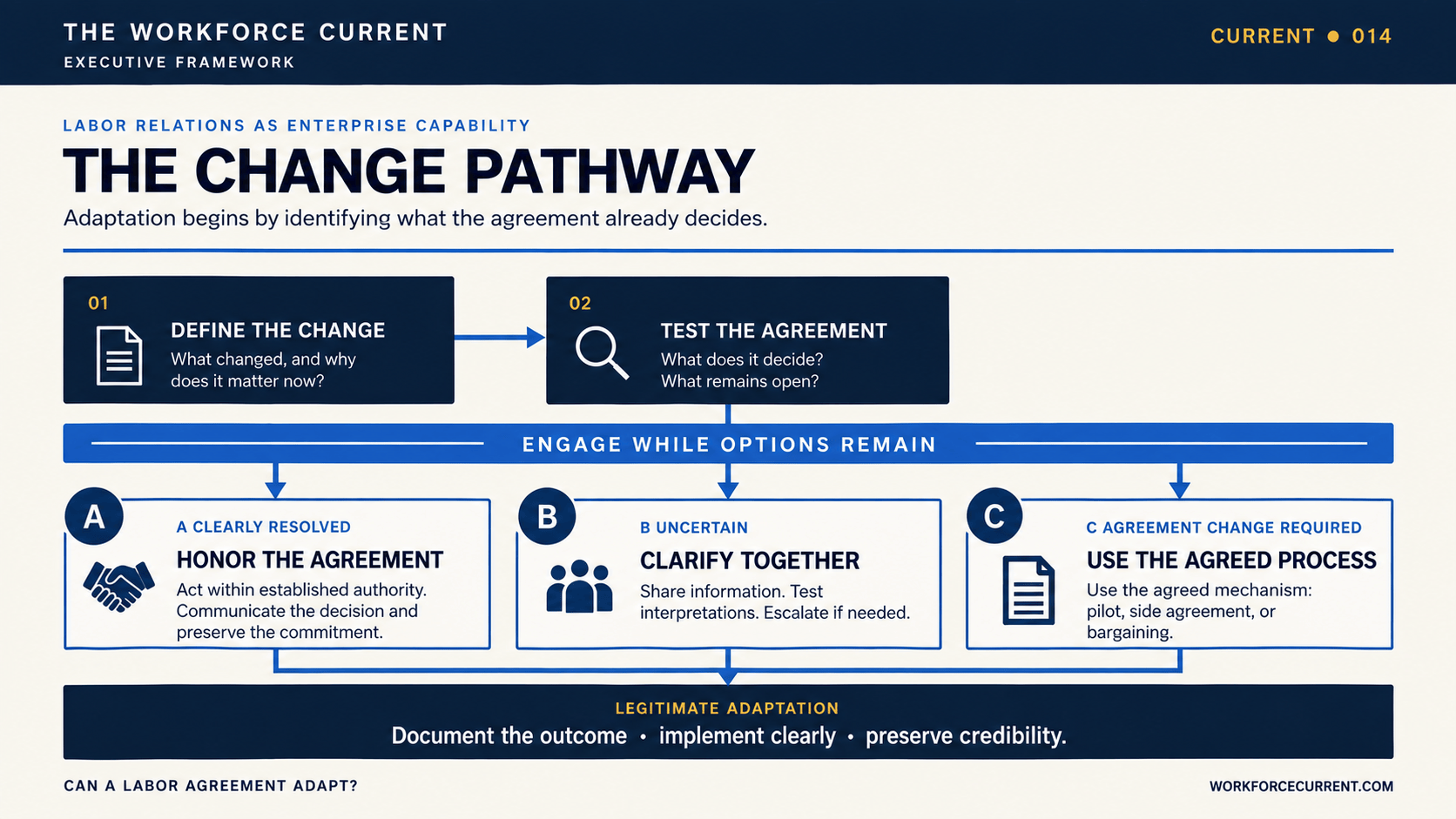
- What does the agreement already decide?
- What remains uncertain?
- Who must be involved?
- Which decisions remain within established authority?
- Which changes require agreement or bargaining?
- How will unresolved issues move forward?
Without answers, each unexpected issue can become a test of power.
Management may conclude that the agreement prevents necessary action. Labor may conclude that management is trying to avoid a negotiated obligation.
Positions harden, motives are questioned, and an operating problem becomes a crisis of legitimacy. The costs compound: investments stall, grievances accumulate, and the distrust carries into the next negotiation.
TIMING PRESERVES OPTIONS
Adaptation becomes hardest when the conversation begins after a decision is effectively complete.
If management approaches labor only after the path forward has been chosen, consultation can feel performative.
If labor treats every proposed change as an attack on existing rights, management may stop raising issues until action becomes unavoidable.
Both behaviors shrink the solution space.
Earlier engagement does not require either side to surrender its rights. It allows the parties to address problems while options remain.
A staffing problem can be discussed before it becomes a crisis. A technology change can be understood before implementation. A skill gap can be addressed before the work depends on capabilities that do not exist.
Early discussion will not eliminate disagreement. Some issues will still require bargaining, grievance handling, arbitration, or the exercise of established authority.
The advantage is not guaranteed consensus.
It is the opportunity to solve the problem before urgency takes control.
ADAPTABILITY HAS BOUNDARIES
Adaptability should not become a slogan used to pressure either party into accepting whatever the other considers necessary.
Some commitments are intentionally difficult to change. Some proposed changes transfer risk, alter jurisdiction, weaken job security, increase costs, or disrupt operations. Resistance may reflect genuine interests, not a dysfunctional relationship.
A healthy labor system does not eliminate conflict.
It makes conflict governable.
That begins by distinguishing among three situations:
- The agreement clearly resolves the issue.
- The agreement leaves the issue uncertain.
- The proposed change requires the agreement itself to be modified.
Consider new automated equipment on a production line. If the agreement’s classification language clearly covers the work, assignment may follow the agreed rules. If that language was written before the technology existed, who performs the work, and at what rate, may be an open question. A proposal to create or merge classifications may require bargaining and an amendment, depending on the agreement and applicable law. The same equipment can raise all three situations.
Confusing them damages credibility.
Treating a clear obligation as an ambiguity weakens the agreement. Treating every ambiguity as a prohibition prevents problem-solving. Treating a desired contract change as routine administration bypasses the process that gives the agreement legitimacy. It can also create legal exposure. In most U.S. settings, terms written into the agreement cannot be changed midterm without the other party’s consent, and changes to other terms and conditions of employment generally require bargaining first.
Adaptability begins with identifying which situation actually exists.
THE EXECUTIVE SIGNAL™
When routine operating changes repeatedly become contractual crises, the problem may not be the agreement. It may be the absence of a credible process for determining what the agreement decides, what remains open, and how unresolved issues move forward.
When every new circumstance becomes a test of power, the labor system is not adapting. It is improvising under pressure.
EXECUTIVE TAKEAWAY
A labor agreement is adaptable when the system around it can respond to unanticipated conditions without making its commitments meaningless.
That requires clear boundaries, early information, and a legitimate pathway for change.
Too much discretion, and the agreement loses credibility.
Too much rigidity, and the system loses responsiveness.
The objective is a labor relationship that can adapt without convincing either side that its commitments no longer matter.
CLOSING PRINCIPLE
A labor relationship that can change without convincing either side that its commitments no longer matter.

Sources: WGA bargaining proposals · WGA AI terms · UAW task force announcement · UAW reopening statement · NLRB bargaining guidance
The Workforce Current provides independent analysis of labor relations, workforce strategy, skilled trades, and leadership. The views expressed are solely those of the author and do not represent any employer or organization.