Capital Can Move Faster Than Capability.
THE WORKFORCE CURRENT | By Michael Shue | CURRENT ● 007
Executive Brief
The previous issue of The Workforce Current examined the physical dependency chain behind artificial intelligence. Compute requires facilities. Facilities require power. Physical infrastructure requires equipment, construction, operations, and people.
This leads to a broader economic question:
What happens when investment moves faster than the workforce capable of executing it?
Capital can deploy quickly. Demand can surge. Projects can multiply. But human capability develops on a different timeline.
Engineers, technicians, skilled craft professionals, operators, supervisors, and project leaders build expertise through education, training, repetition, and experience. That process cannot be compressed indefinitely.
Investment creates demand. Capability determines how much of that demand can actually be delivered.
Capacity Is Not Headcount
Workforce discussions often collapse into a single question: Do we have enough workers?
That question is incomplete.
A labor market can show thousands of available workers and still lack the specific capabilities required to execute complex work. More relevant questions include whether the right skills exist, whether they are located where demand is emerging, whether workers hold the necessary credentials and experience, and whether sufficient supervision exists to execute work safely and effectively.
Mobility is also a constraint. Qualified workers may exist but not in the regions where demand is concentrated. Training systems may be able to recruit new entrants but lack instructors, facilities, or experienced mentors to scale development.
As a result, a workforce can appear sufficient on paper while remaining constrained in practice.
Headcount measures people. Capacity measures execution.
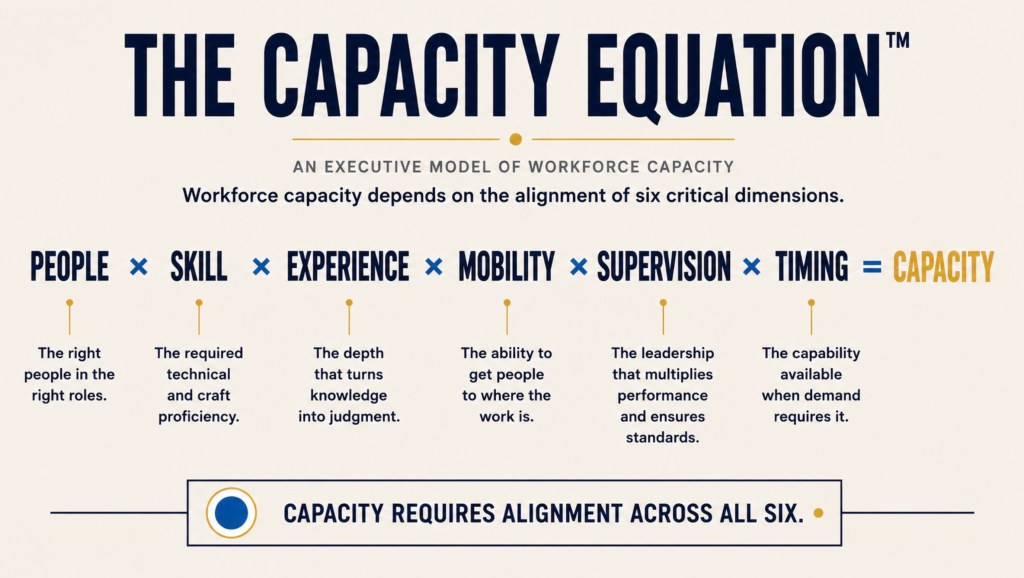
The Capacity Equation™
Workforce capacity is determined by multiple interconnected variables:
PEOPLE × SKILL × EXPERIENCE × MOBILITY × SUPERVISION × TIMING
A weakness in any one dimension can limit the entire system.
There may be applicants, but insufficient specialized skill. There may be skilled workers, but not in the right locations. Training programs may attract candidates but lack instructional depth or structured experience pathways.
A workforce may also have strong technical talent but insufficient experienced supervision to scale safely. Even when all elements exist, they must align at the right moment.
The constraint is rarely simple labor supply. It is alignment between capability and demand.
The workforce challenge is not just finding people. It is ensuring the right capability, in the right place, at the right time.
THE EXECUTIVE SIGNAL™
Watch the Constraint Before It Becomes Visible
Organizations typically recognize workforce constraints only when they become immediate. Roles remain unfilled, competition for talent intensifies, experienced employees become harder to replace, and execution slows.
These are lagging indicators.
Technical expertise requires years of education and practice. Skilled trades require structured training and repetition. Supervisors develop through progressive responsibility. Institutional knowledge accumulates over time.
By the time a capability gap is obvious, the fastest path to resolution may already be closed.
The more effective leadership question is not what is missing today, but what capabilities will be required several years from now.
This shifts workforce planning from reaction to anticipation.
Leaders can test that exposure using The Workforce Capability Diagnostic.
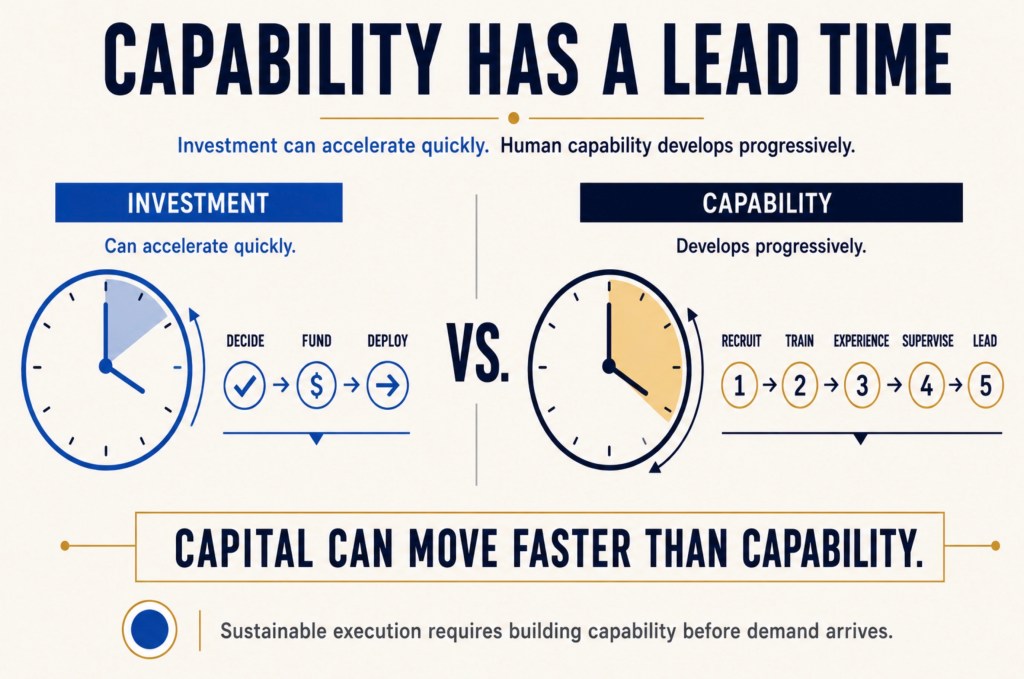
Capability Has a Lead Time
Organizations understand lead time in physical systems. Factories take time to build. Equipment takes time to manufacture. Infrastructure takes time to deliver.
Human capability has lead time as well.
An apprentice entering a skilled trade today may require years of combined instruction and supervised experience before reaching full proficiency. Engineers and technicians similarly develop judgment through education followed by applied work.
Experienced supervisors require something even less compressible: time leading real work and making real decisions.
During periods of rapid investment, this creates structural tension. Economic demand can accelerate faster than capability development systems can respond. When multiple sectors expand simultaneously, competition intensifies for overlapping pools of engineers, technicians, skilled trades, operators, and experienced leaders.
Workforce capacity is therefore an economic variable, not just an employment statistic.
Scale Without Dilution
The default response to workforce pressure is to recruit more people.
That is necessary, but recruitment is only the entry point into a capability system.
New entrants require development. That requires instructors, training infrastructure, equipment, structured experience, coaching, and mentorship. Leadership development requires opportunities to exercise judgment under increasing responsibility.
These systems must scale alongside workforce growth. Expanding headcount without expanding development capacity simply shifts the bottleneck downstream.
The objective is not speed at the expense of standards, nor artificial scarcity. It is responsible scale—expanding access while preserving the knowledge, safety, and performance standards that define true capability.
The goal is not a larger workforce. It is a larger capable workforce.
The Visibility Problem
Another constraint is visibility: organizations and individuals cannot prepare effectively for demand they cannot see.
Students choose educational paths. Workers decide whether to enter apprenticeships. Training institutions allocate resources. Employers invest in capability development. Communities shape education systems.
These decisions are made before future demand is fully known.
This creates a signaling challenge. The clearer the economy is about where durable capability will be needed, the more effectively individuals and institutions can prepare.
This does not require perfect forecasting. It requires acknowledging that workforce development is inherently forward-looking.
Today’s training decisions determine tomorrow’s productive capacity.
From Labor Supply to Capability Strategy
This distinction reframes workforce strategy.
Traditional planning begins with a question: How many people are needed?
Capability strategy begins differently:
What must people be able to do?
From there, the strategic questions emerge. Which capabilities will increase in value? Which take the longest to develop? Where is experience hardest to replace? Which skills can technology augment, and which require human judgment? Where will industries compete for the same talent?
Most importantly, which capabilities must begin developing before demand becomes visible?
These questions align workforce planning with business strategy, because organizations do not execute strategy through org charts.
They execute it through capability.
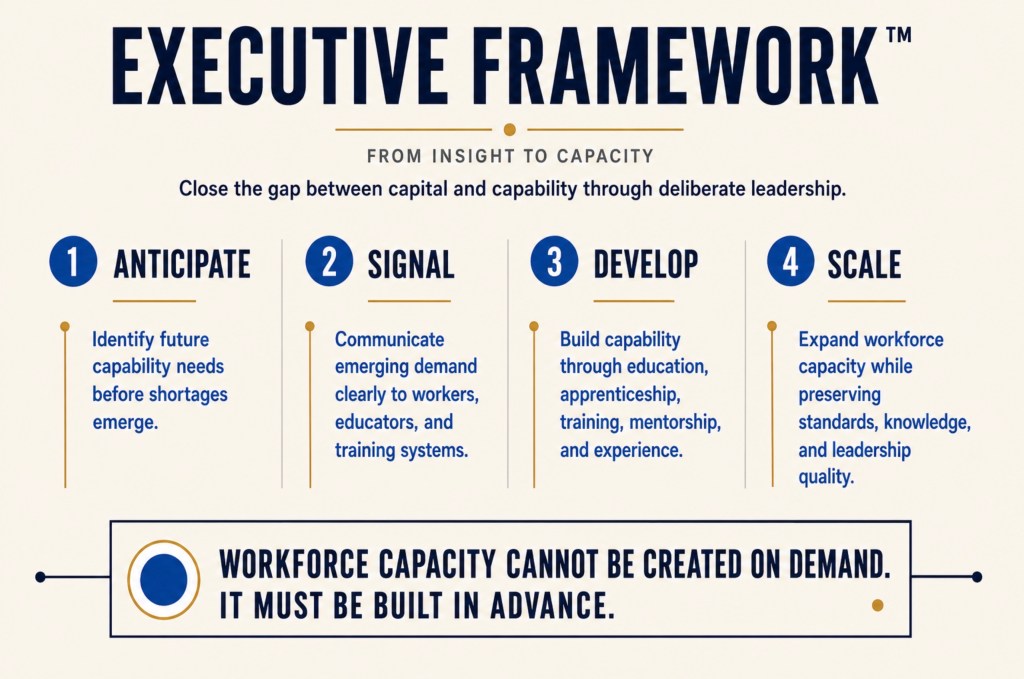
Executive Framework™
ANTICIPATE → SIGNAL → DEVELOP → SCALE
ANTICIPATE — Identify future capability needs before shortages emerge.
SIGNAL — Communicate emerging demand clearly to workers, educators, and training systems.
DEVELOP — Build capability through education, apprenticeship, training, mentorship, and experience.
SCALE — Expand workforce capacity while preserving standards, knowledge, and leadership quality.
Workforce capacity cannot be created on demand. It must be built in advance.
Executive Takeaway
The next constraint on economic growth may not be capital, technology, or physical infrastructure. It may be human capability—the ability to convert those inputs into productive output.
That capability cannot be instantly created. It must be developed over time through education, experience, and leadership growth. Most importantly, it must begin before scarcity makes the need obvious.
This elevates workforce development beyond hiring or labor market response. It becomes a core system for enabling growth itself.
CAPITAL CAN FUND GROWTH. CAPABILITY DETERMINES WHETHER IT CAN BE BUILT.
FREE EXECUTIVE RESOURCE
The Workforce Capability Diagnostic
Can your workforce execute your strategy?
Use this free 10-minute diagnostic to evaluate five dimensions of workforce capability and identify where development time could place strategy at risk.
Free. Ungated. Downloadable PDF.
NEXT CURRENT ● 008
WORKFORCE AT THE SPEED OF STRATEGY
Strategy can shift quickly. Human capability cannot.
What happens when organizational direction changes faster than workforce capability can adapt?
Coming next in The Workforce Current.
The Workforce Current reflects the independent views and analysis of Michael Shue. It is not affiliated with, sponsored by, or representative of his employer or any other organization.
