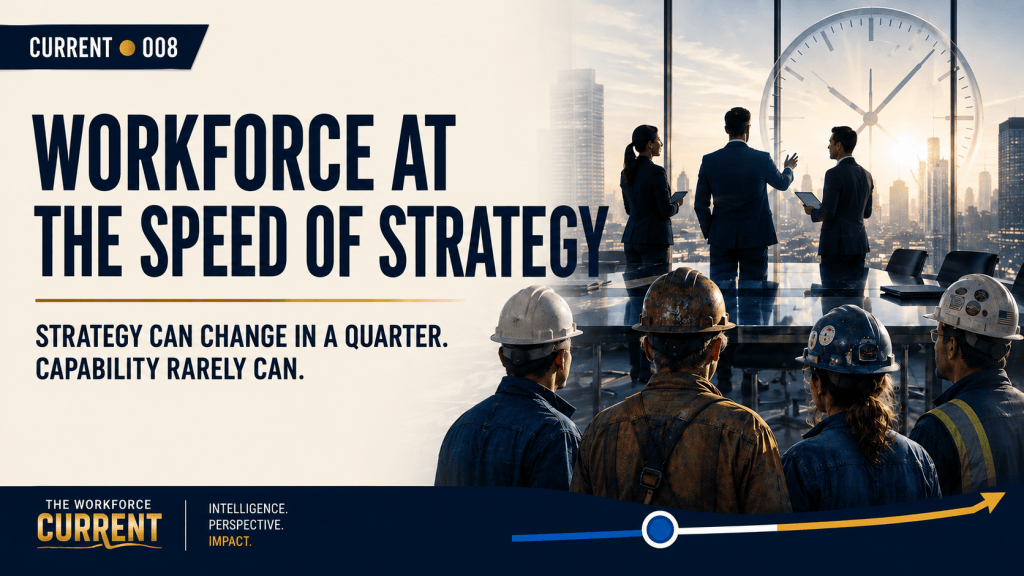
Strategy Can Change in a Quarter. Capability Rarely Can.
THE WORKFORCE CURRENT | By Michael Shue | CURRENT ● 008
Executive Brief
Modern enterprises can change direction remarkably quickly.
Capital can be redirected. Technology can be deployed. Businesses can be acquired. Operating models can be redesigned. Strategic priorities can shift.
Human capability operates on a different clock.
Expertise must be developed. Experience must be accumulated. Judgment must be earned. Leadership capacity must mature.
That creates an increasingly important strategic mismatch:
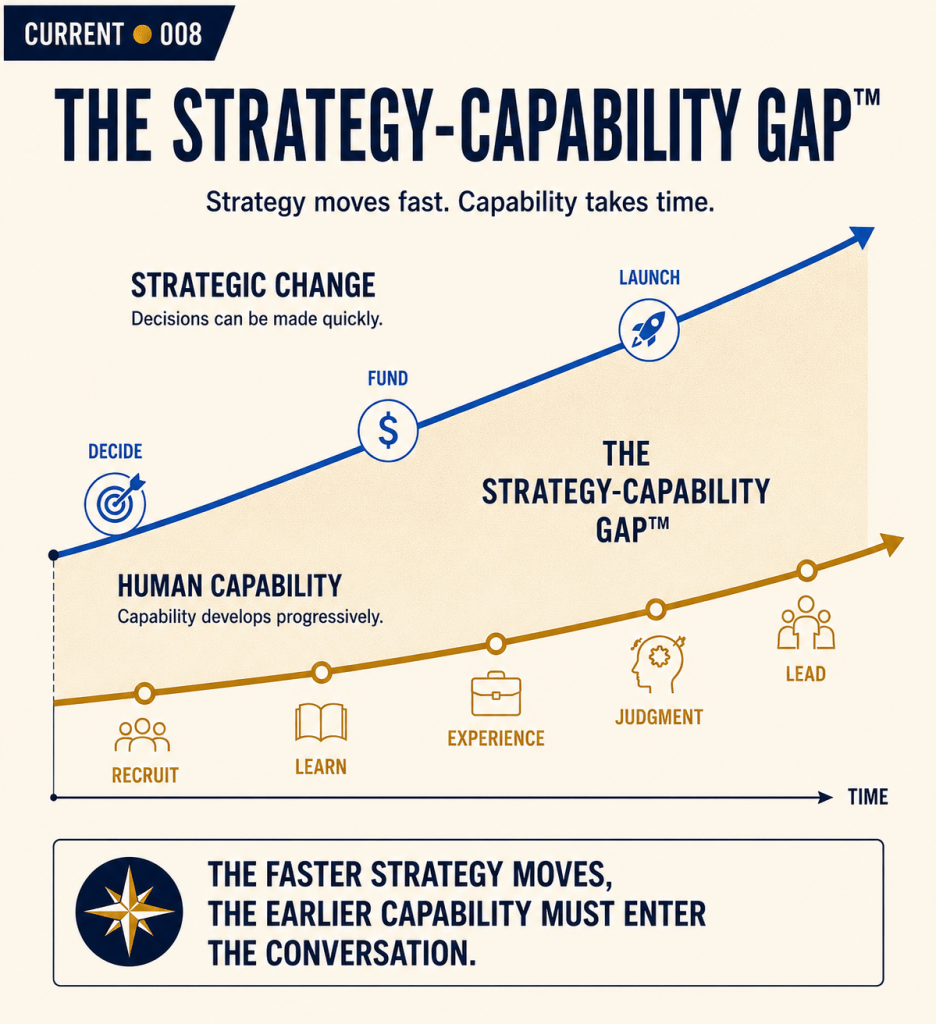
The enterprise can change direction faster than the workforce can develop every capability the new direction requires.
The question is not simply whether an organization has enough people.
It is whether it can develop, acquire and deploy the right capability at the speed its strategy demands.
The Strategy-Capability Gap
Organizations cannot wait until every required capability exists before pursuing strategy.
But leaders cannot assume the labor market will provide precisely the expertise they need, precisely when they need it.
Every major strategy therefore carries an embedded workforce question:
How quickly can the organization assemble the human capability required to execute it?
The answer can influence the speed, sequence and risk of the strategy itself.
The Capability Gap Test provides a practical way to compare Strategic Demand, Current Capability, Build Time and Execution Exposure.
Technology may be available immediately. The people capable of integrating, operating and improving it may not be.
Capital for expansion may be approved this quarter. Developing the skilled workforce required to build, commission and operate that expansion can take considerably longer.
An acquisition may close in months. Integrating operating practices, leadership systems and institutional knowledge can take considerably longer.
The strategic decision may be fast.
The capability curve usually is not.
THE CONSTRAINT IS ALREADY VISIBLE
The World Economic Forum’s Future of Jobs Report 2025 found that 63% of surveyed employers identified skills gaps in the labor market as a major barrier to business transformation—the most frequently cited barrier in the survey.
Capability is not simply a workforce issue. It can become a constraint on transformation itself.
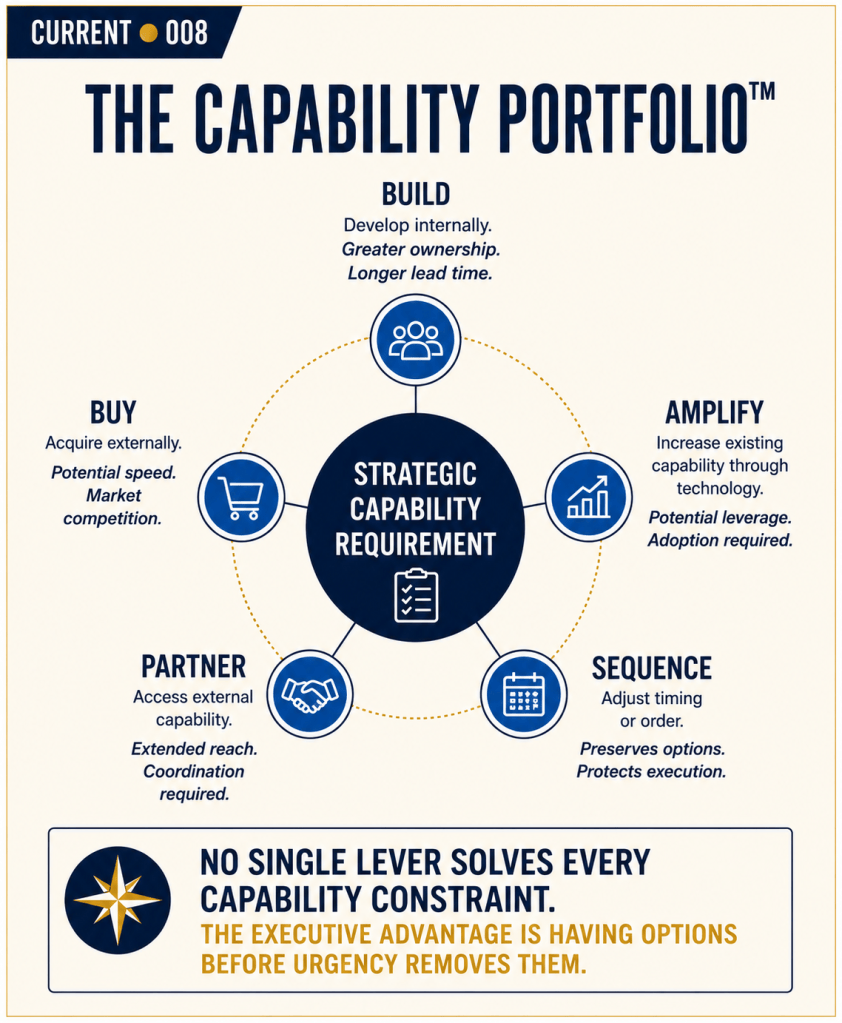
The Capability Portfolio™
When strategy creates a new capability requirement, leaders have five fundamental levers:
BUILD — Develop capability internally through recruiting, training, experience and leadership development.
BUY — Acquire experienced talent from the external market.
AMPLIFY — Use technology to increase the capability or productivity of the existing workforce.
PARTNER — Access capability through contractors, suppliers, labor partners, educational institutions or other external relationships.
SEQUENCE — Adjust the timing or order of strategic initiatives when critical capability cannot responsibly be accelerated.
None is universally superior.
The executive task is determining the right combination before urgency eliminates the alternatives.
THE EXECUTIVE SIGNAL™
Workforce planning should not merely translate completed strategy into hiring requirements.
It should inform strategic feasibility before commitments harden.
If growth depends on scarce expertise, that matters.
If technology requires substantial reskilling, that matters.
If an operating model assumes capabilities the organization does not yet possess, that matters.
If multiple strategic initiatives compete for the same limited technical or leadership capacity, that matters too.
Not because workforce considerations should veto strategy.
Because they help leaders understand what the strategy will actually require to execute.
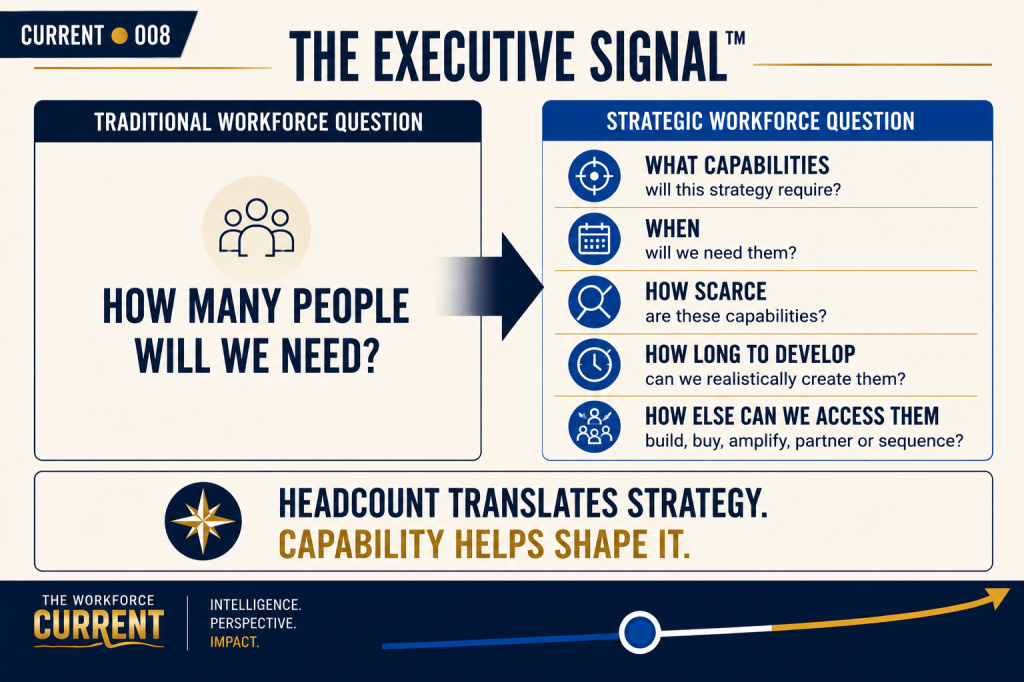
Instead of asking:
“How many people will we need?”
Leadership should also ask:
“What capabilities will this strategy require, when will we need them, and how quickly can we realistically create or access them?”
That is strategic workforce planning at executive altitude.
Executive Takeaway
The objective is not perfect forecasting.
The future will remain uncertain.
The objective is to identify foreseeable capability constraints early enough to preserve choices.
Build it. Buy it. Amplify it. Partner for it. Or sequence the strategy around it.
Wait too long, and those choices narrow.
Recruiting becomes urgent. Training becomes compressed. External talent becomes more expensive. Partners become harder to secure. Execution risk rises.
Time is not merely a planning variable.
Time is a strategic workforce asset.
BUILD CAPABILITY BEFORE URGENCY REMOVES YOUR OPTIONS.
Source
World Economic Forum, Future of Jobs Report 2025, “Workforce strategies,” January 2025. The report surveyed more than 1,000 employers representing more than 14 million workers across 55 economies.
FREE EXECUTIVE RESOURCE
The Workforce Capability Diagnostic
Can your workforce execute your strategy?
Use this free 10-minute diagnostic to evaluate five dimensions of workforce capability and identify where development time could place strategy at risk.
Free. Ungated. Downloadable PDF.
NEXT CURRENT ● 009
THE FRONT LINE IS WHERE STRATEGY BECOMES REAL
Strategy may be designed at executive altitude. Execution happens on the front line.
What happens when enterprise strategy reaches the people, supervisors and operating systems responsible for turning direction into results?
Coming next in The Workforce Current.
Editorial Disclaimer
The Workforce Current reflects the independent views and analysis of Michael Shue. It is not affiliated with, sponsored by, or representative of his employer or any other organization.
