
Bargaining Begins Before Bargaining™
The Workforce Current | By Michael Shue |CURRENT ● 010
Executive Brief
Collective bargaining has a formal beginning.
Notice is given.
Teams assemble.
Proposals are exchanged.
Deadlines become real.
But the environment surrounding those negotiations began forming much earlier.
When a grievance was resolved—or wasn’t.
When an operational change was introduced.
When information was shared early, late, or not at all.
When a commitment was made and kept.
Or wasn’t.
By the time the parties reach the bargaining table, they bring accumulated experience with them.
That experience shapes what they expect from one another, how they interpret information and whether commitments are considered credible.
BARGAINING BEGINS BEFORE BARGAINING.™
Formal negotiations start on a date.
The environment in which they occur is built over time.
The Table Inherits the Relationship
Negotiations do not begin with a blank sheet of paper.
Consider two bargaining relationships confronting the same difficult proposal.
In one, the parties have a history of exchanging credible information, resolving problems and honoring commitments.
In the other, information arrives late. Problems escalate unnecessarily. Commitments are disputed. Surprises are common.
The proposal may be identical.
The bargaining environment is not.
A request for flexibility may be evaluated through management’s previous use of discretion.
A workforce concern may be evaluated through the union’s history of raising credible issues.
An economic explanation may be received differently if previous information proved reliable.
Economic interests still diverge. Priorities still conflict.
But the table inherits what the parties have learned to expect from one another.
Relationships Accumulate History
Labor relationships develop through ordinary interactions, not only major events.
A difficult issue handled well matters. So does a commitment that is forgotten.
A grievance left unresolved creates one experience. A legitimate concern addressed early creates another.
A change explained before implementation is different from when employees discover after the decision is effectively complete.
These interactions create patterns. Patterns shape expectations.
Research on industrial relations supports the underlying mechanism: relational trust can develop through repeated formal and informal interactions, reinforced by institutional structures.
People change. Organizations change. But practices, reputations, unresolved issues and shared understandings can persist.
The relationship carries history forward.
What Happens Between Negotiations
Most interactions that eventually shape the bargaining environment do not look like bargaining when they occur. Nor should they.
A scheduling decision should not become a bargaining tactic. A grievance should not be handled for its effect on the next negotiation.
The point is simpler:
Day-to-day administration creates evidence about how the relationship actually works.
A scheduling decision demonstrates how discretion is exercised.
A contract interpretation demonstrates how language is administered.
A request for information demonstrates how information moves.
A local dispute demonstrates whether problems can be solved before they escalate.
The parties learn what to expect from one another by repeatedly working with one another.
The Federal Mediation and Conciliation Service (FMCS) reflects this principle by providing preventive mediation, facilitation, and training during the life of collective bargaining agreements—not only at contract expiration—to strengthen problem-solving, communication, and labor-management relationships.
The work between negotiations helps create the conditions for the negotiations that follow.
The Front Line Shapes the Relationship
The labor relationship is not administered only by the people who eventually sit at the bargaining table.
Supervisors administer it every day. So do stewards and union representatives.
Employees experience the relationship through decisions about scheduling, overtime, work assignments, coaching and discipline, contract interpretation, responses to concerns and the exercise of discretion.
Individually, these decisions appear tactical. Collectively, they shape how the employment system is experienced.
FMCS relationship-development materials likewise recognize frontline roles through steward-supervisor training in contract administration, grievance processing and interpersonal communication.
The next negotiation is being influenced by people who may never enter the bargaining room.
Not Every Problem Should Become a Position
A functional labor relationship needs formal processes.
Some disputes should become grievances. Some grievances require arbitration. Some disagreements belong at the bargaining table.
The objective is not to suppress legitimate conflict.
The problem begins when formal processes become the only way the relationship can solve problems.
When every issue becomes positional, argument can begin before the underlying problem is understood.
The reverse is dangerous too. Avoiding legitimate disputes in the name of preserving the relationship can weaken representation and allow problems to accumulate.
Know what needs to become a dispute—and what still has the opportunity to become a solution.
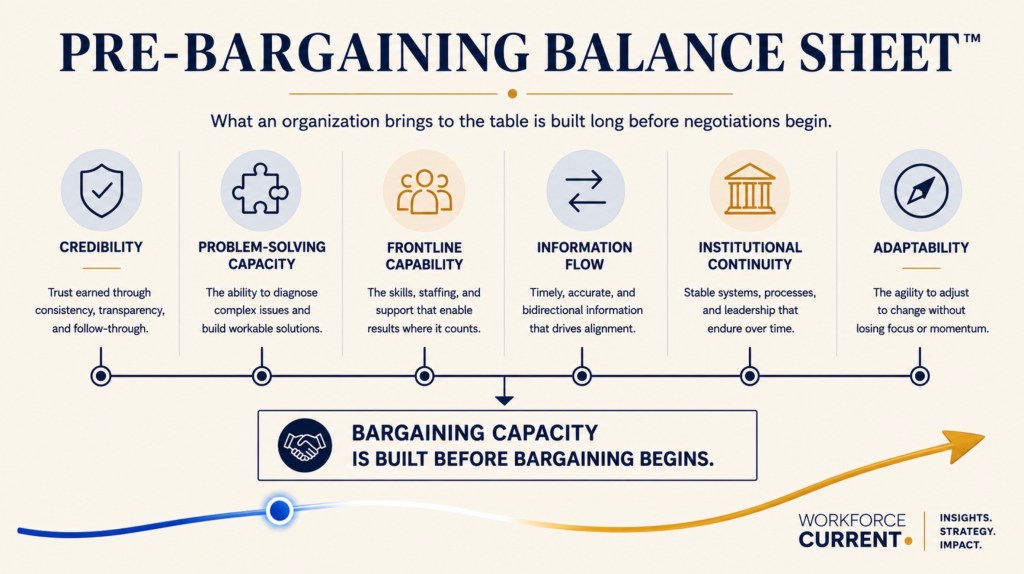
The Pre-Bargaining Balance Sheet
CREDIBILITY
Can information and commitments generally be relied upon?
PROBLEM-SOLVING CAPACITY
Can routine issues be resolved without unnecessary escalation?
FRONTLINE CAPABILITY
Do supervisors and union representatives understand the agreement and their respective roles?
INFORMATION FLOW
Can difficult information move before positions become fixed?
INSTITUTIONAL CONTINUITY
Are important commitments, recurring issues and previous understandings carried forward?
ADAPTABILITY
Can changing operating conditions be addressed without every change becoming a crisis?
Are the parties accumulating institutional capacity—or institutional friction?
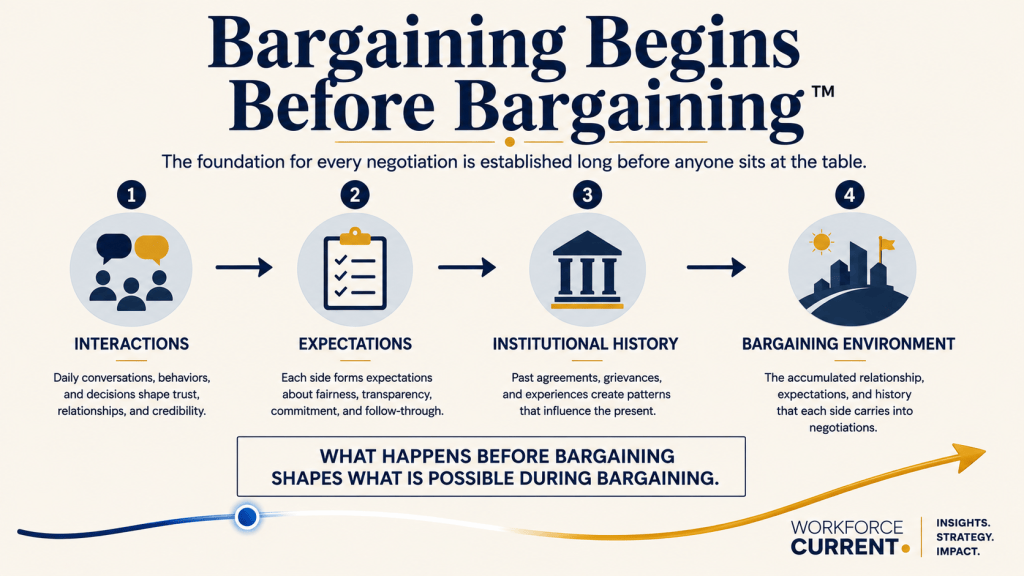
Bargaining Begins Before Bargaining™
The model is straightforward:
INTERACTIONS → EXPECTATIONS → INSTITUTIONAL HISTORY → BARGAINING ENVIRONMENT
Not every interaction matters equally. Not every expectation persists. Relationship quality does not determine bargaining outcomes.
But the parties enter negotiations with prior experience of how information moves, how commitments are handled, how disagreements escalate and whether problems can be solved.
Bargaining preparation therefore involves more than assembling the team, developing proposals, analyzing economics and determining priorities.
What kind of relationship are we bringing into the room?
That answer cannot be manufactured in the final weeks before negotiations.
Much of it has already been built.
The Executive Signal™
Between contracts, executives should ask:
Are commitments being honored?
Are recurring disputes revealing something about the operation?
Are supervisors and union representatives building problem-solving capacity—or dependence on escalation?
If bargaining started tomorrow, what relationship would we bring to the table?
The answer is being built today.
Executive Takeaway
Collective bargaining has formal starting points.
The relationship does not.
Decisions, disputes, commitments and conversations between agreements create expectations.
Those expectations become part of the institutional history the parties eventually bring to the table.
BARGAINING BEGINS BEFORE BARGAINING.™
THE TABLE TESTS WHAT THE RELATIONSHIP HAS BEEN BUILDING ALL ALONG.

The Workforce Current provides independent analysis and commentary on labor relations, workforce strategy, skilled trades and leadership. The views expressed are solely those of the author and do not represent any employer or organization.
NEXT CURRENT ● 011
WHEN A COMMITMENT STOPS MEANING ANYTHING
Reaching agreement is one thing.
Believing the commitment will survive difficult circumstances is another.
Source Notes
1. Ulfsdotter Eriksson, Y., Larsson, B., & Sjöstrand, G. (2026). Trust in ‘the Swedish model’: Exploring relational, institutional and personal trust in Swedish industrial relations. Economic and Industrial Democracy. DOI: 10.1177/0143831X261425504.
2. Federal Mediation and Conciliation Service. Preventative Mediation. Current service description accessed August 24, 2026.
3. Federal Mediation and Conciliation Service. Relationship-Development and Training materials, including Contract Administration/Steward-Supervisor Training.
