Why One of Our Greatest Workforce Opportunities Remains Hidden
The Workforce Current | Issue # 004 | By Michael Shue
Executive Brief
Executives regularly ask where the next generation of skilled professionals will come from.
The conversation usually focuses on expanding apprenticeships, increasing training capacity, and creating more career pathways.
Those efforts matter.
But they overlook an earlier question.
How do young people decide which careers are worth pursuing?
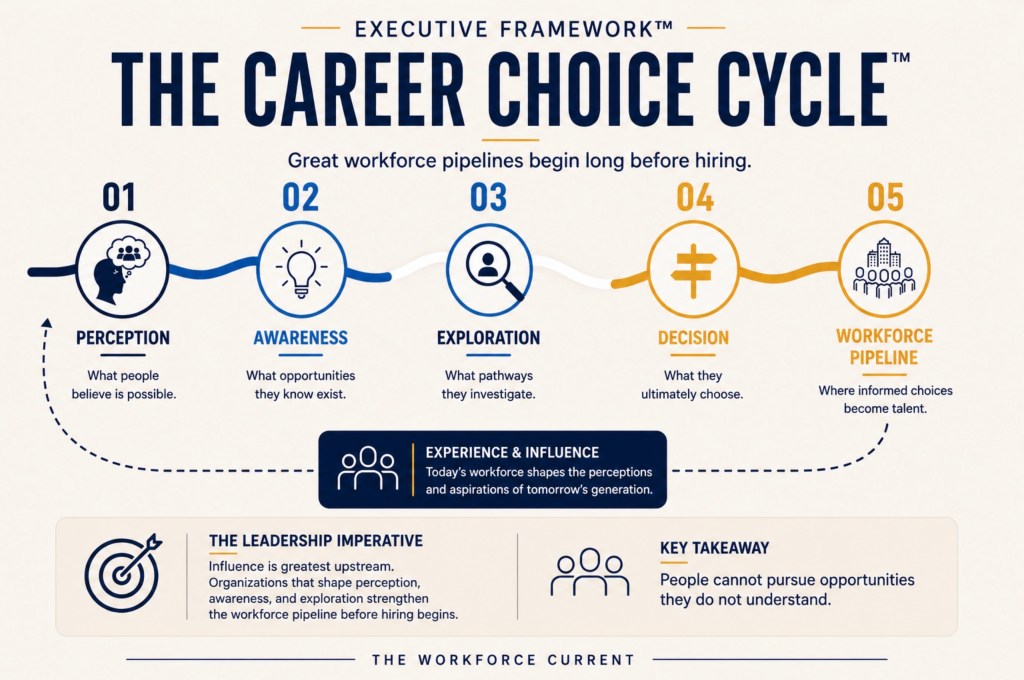
Career choices are shaped long before graduation by parents, teachers, counselors, mentors, peers, media, and society’s definition of success.
If talented young people never seriously consider the skilled trades, the workforce pipeline narrows long before an apprenticeship application is submitted.
America’s challenge is not simply developing more talent.
It is ensuring talented people understand the full range of high-quality career pathways available to them before making one of the most important decisions of their lives.
A Leadership Moment
Imagine two high school seniors announcing their plans after graduation.
One will attend a four-year university.
Friends applaud.
Teachers congratulate them.
Family members celebrate.
The other will begin an electrical apprenticeship.
The response is often more hesitant.
“Have you thought about college instead?”
“Are you sure?”
Neither student has started a career.
Yet their decisions may be viewed very differently.
That matters because career choices are rarely made in isolation. Parents, teachers, counselors, mentors, and other trusted adults help shape how young people view different career pathways.
Perception begins influencing workforce pipelines years before employers begin recruiting.
The Awareness Gap
The modern skilled trades bear little resemblance to many of the stereotypes that continue to define them.
Today’s craft professionals build artificial intelligence data centers, nuclear power plants, semiconductor fabrication facilities, advanced manufacturing campuses, hospitals, energy infrastructure, and the electric transmission systems that power modern society.
Their work increasingly combines advanced technology, precision, problem-solving, continuous learning, and technical expertise.
Registered Apprenticeships combine paid employment, structured education, mentorship, progressive skill development, and nationally recognized credentials.
Yet many students and parents recognize the word apprenticeship without fully understanding the opportunity behind it.
Research shows that interest often increases when families learn about the wages, credentials, career advancement, and long-term opportunities apprenticeships can provide.
The challenge is not simply a lack of respect.
It is often a lack of complete information.
America benefits from universities, community colleges, military service, employer-sponsored training, entrepreneurship, and apprenticeship programs.
The objective is not to steer every student toward one pathway.
It is to ensure every student understands all of them.
Why Career Awareness Matters
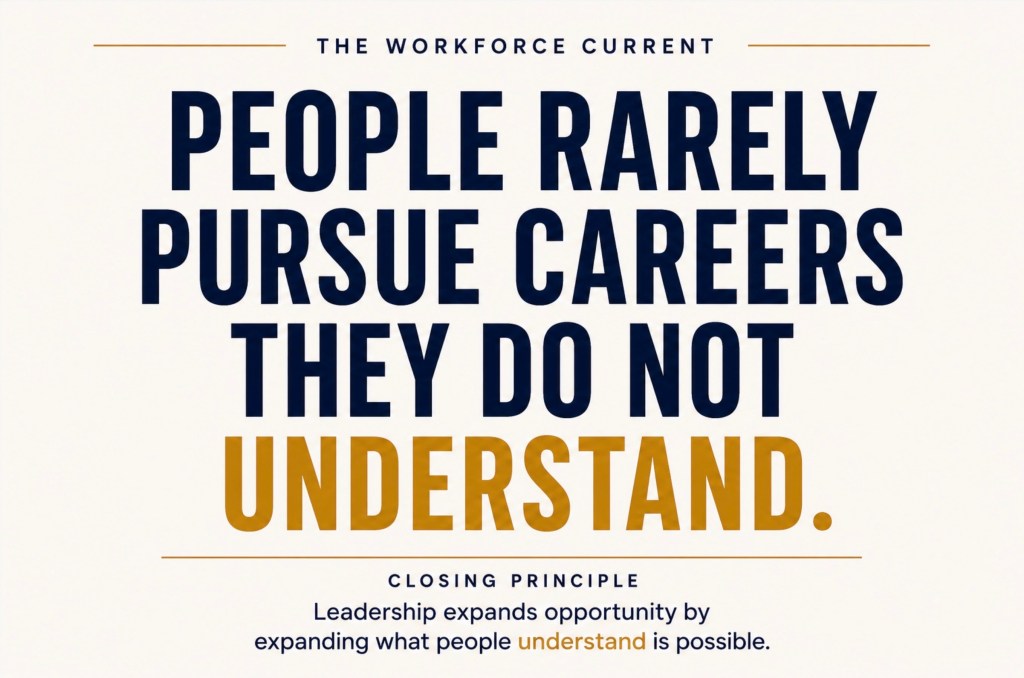
Young people rarely pursue careers they know little about.
Career awareness is one of the earliest stages of workforce development.
Across America, employers, labor organizations, educators, workforce organizations, industry associations, and nonprofit organizations are working to increase awareness of skilled careers.
TradesFutures is one example, connecting career awareness with apprenticeship readiness and visible pathways into skilled trades careers.
Its work reflects a simple principle.
Awareness is most powerful when it leads somewhere.
Four Leadership Principles Every Executive Can Apply
Whether an organization is unionized or nonunion, public or private, four leadership principles emerge.
Build Pride in the Profession
People pursue careers they understand and respect.
Industries shape that perception through the stories they tell and the people they celebrate.
Influence Before Decisions Are Made
Career exploration should begin years before graduation.
Exposure creates possibility.
Let Reality Replace Stereotypes
Modern skilled trades are defined by advanced technology, structured education, craftsmanship, safety, and lifelong learning.
Public perception should reflect today’s work—not yesterday’s assumptions.
Every Professional Represents the Brand
Employers.
Educators.
Labor organizations.
Industry associations.
Current craft professionals.
Every interaction influences the next generation.
The strongest career story is one employees are proud to tell.
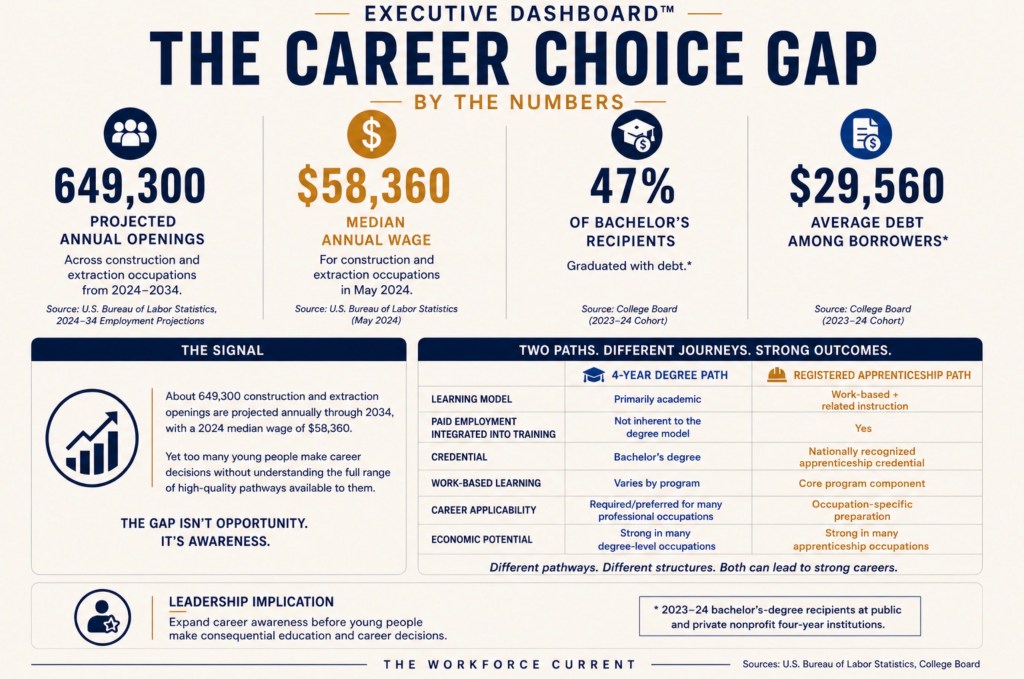
By the Numbers
649,300
Projected annual openings across skilled craft occupations through 2034.
$58,360
Median annual wage for skilled craft occupations.
47%
Share of recent bachelor’s-degree recipients who graduated with student debt.
$29,560
Average debt among those borrowers.
Sources: U.S. Bureau of Labor Statistics and College Board.
Why It Matters Now
Artificial intelligence.
Nuclear power.
Semiconductor manufacturing.
Advanced manufacturing.
Electric transmission.
Grid modernization.
Data centers.
Each depends on highly skilled craft professionals.
Those professionals come from many workforce pathways.
Every pathway depends on talented people choosing it.
Technology will continue to evolve.
The need for exceptionally skilled people will not.
Changing career awareness is not simply a communications challenge.
It is a long-term workforce strategy.
Career branding may open the door.
The employment experience determines whether talented people stay.
Executive Takeaway
Organizations frequently ask how to build larger workforce pipelines.
A better question may be:
What story are we telling about the careers we hope people will choose?
Great workforce systems do not begin with recruiting.
They begin with awareness.
They continue through education.
They succeed through opportunity.
Whether an organization is unionized or nonunion, public or private, the leadership lesson is the same.
Exceptional workforce pipelines are intentionally built—not accidentally inherited.
People cannot pursue opportunities they do not understand.
America’s future workforce will ultimately be shaped not only by the opportunities that exist, but by the opportunities young people can see themselves pursuing.
About
The Workforce Current
The Workforce Current explores leadership, labor relations, workforce strategy, skilled trades, energy, manufacturing, and the future of work. Each issue examines practical leadership ideas that strengthen organizations and the people who make them successful.
Looking Ahead
Issue #005
The Workforce We Already Trained
What Helmets to Hardhats Can Teach Leaders About Recognizing Talent
Editorial Disclaimer
The views expressed in The Workforce Current are my own and are intended to encourage thoughtful discussion about leadership, workforce strategy, labor relations, and the future of work. They do not necessarily represent the views of my employer or any organization with which I am affiliated.
