
Credibility is built—or lost—long before the next contract.
THE WORKFORCE CURRENT | By Michael Shue | CURRENT ● 011
Executive Brief
Most commitments in labor relations are not tested when they are made.
They are tested later.
When circumstances change. When the person who made the commitment leaves. When complying becomes inconvenient. When a different supervisor interprets the situation differently. When operating pressure creates an incentive to reconsider what everyone thought had already been settled.
That is when the parties learn whether the commitment was durable—or merely convenient.
A labor relationship does not require agreement on everything.
It does require some confidence that agreements, representations and understandings will retain meaning after the meeting ends.
When commitments repeatedly fall under pressure, the damage extends beyond the individual issue.
The next commitment becomes harder to believe.
And eventually, credibility itself becomes part of the dispute.
A commitment has value only to the extent the other party expects it to survive the moment in which it was made.
Agreement Is Not the Same as Credibility
Two parties can reach exactly the same agreement and leave with very different levels of confidence in it.
In one relationship, previous commitments have generally been carried forward. People may disagree about what the agreement requires, but once an issue is settled, the settlement usually means something.
In another, commitments seem conditional. They depend on who is in the room, what operation is affected, who becomes involved later, or whether the commitment remains convenient.
The words may be identical. The institutional meaning is not.
That distinction matters because labor relations depends heavily on decisions made under uncertainty.
A union representative must decide whether management’s explanation can be relied upon. A supervisor must decide whether a union commitment will hold with the workforce.
Both sides sometimes accept an imperfect resolution because they believe the other party will do what it said it would do.
That belief reduces the number of things that must be formalized, escalated, documented or litigated.
It is the practical side of the argument in Current ● 002: trust is the real collective bargaining agreement.
When credibility deteriorates, the opposite occurs.
Everything begins to require proof.
The Credibility Tax
Weak commitment credibility rarely appears as a line item on a financial statement. But organizations can still pay for it.
A simple issue requires another meeting. A verbal understanding requires a confirming email. An explanation requires documentation. A local decision is escalated because no one wants to rely on an informal resolution. A tentative solution becomes difficult because each side fears the other will later reinterpret it.
More people become involved. More positions become protected. More time is spent establishing what happened rather than solving what happens next.
None of those behaviors is necessarily irrational. In a low-credibility environment, they may be entirely rational.
That is the problem.
When people stop trusting commitments, they build protection around every interaction.
The administrative burden grows because the relationship can no longer carry as much weight on its own.
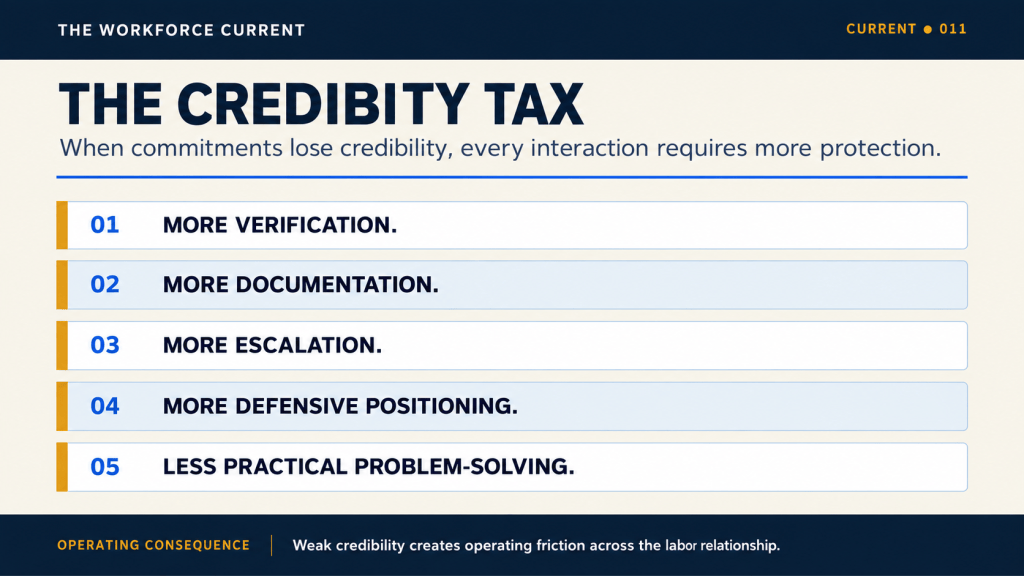
The organization pays what might be called a credibility tax:
- More verification.
- More documentation.
- More escalation.
- More defensive positioning.
- Less room for practical problem solving.
That does not mean documentation is bad or formal processes are unnecessary. Collective bargaining agreements, grievance procedures and written settlements exist for good reason.
The distinction is between appropriate institutional discipline and a relationship in which nearly every interaction requires additional protection because ordinary assurances have lost value.
The question here is institutional reliability, not whether every informal representation creates a legal or contractual obligation.
How Commitments Lose Their Meaning
Most credibility failures are not dramatic. They accumulate.
A supervisor makes a representation without the authority to make it. A commitment is made but never recorded. A leadership transition occurs and the new person has no knowledge of the prior understanding. A local practice develops that contradicts what was previously communicated. A difficult operational situation arrives and an earlier commitment is quietly abandoned.
Consider a composite example. A supervisor and a steward agree that weekend overtime will rotate by seniority. Nothing is written down; both treat the matter as settled. A year later, the supervisor is promoted. Her replacement, short-staffed on a Friday afternoon, assigns the weekend by availability.
To him, it is a routine staffing decision. To the crew, it is a broken promise. The next time a supervisor offers an informal resolution, the steward asks for it in writing.
One side remembers the substance. The other remembers the caveat.
Sometimes there was never a shared understanding in the first place.
Not every disputed commitment is a broken promise.
People can hear the same conversation differently. Ambiguous language can create sincere disagreement. Organizational roles can change. Legal or operational circumstances can make prior assumptions obsolete.
The useful question is therefore not: “Who broke the promise?” It is: “What allowed the commitment to lose institutional meaning?”
That question shifts the analysis from accusation to system capability.
A Commitment Must Survive the Organization
The weakest commitments depend entirely on individual memory.
Someone said it. Someone heard it. Everyone involved understood what was intended.
Then people move. Roles change. Supervisors rotate. Union officers change. Organizations restructure.
And the relationship discovers that what everyone once “knew” was never actually institutionalized.
This is one reason institutional continuity matters.
A functional labor-relations system must be capable of carrying important commitments forward even when the people involved change.
That does not mean converting every conversation into contractual language. It means knowing which commitments are consequential enough to preserve.
- What was decided?
- Who owns the follow-through?
- Was the commitment temporary or ongoing?
- Were there conditions attached?
- Who else needs to understand it?
- Where will the institutional record live?
Those are mundane questions. Until no one can answer them. Then they become labor-relations questions.
Credibility Is Reciprocal
Management does not have a monopoly on the obligation. Neither does labor.
A union can lose credibility when leaders make commitments they cannot deliver to the membership. Management can lose credibility when operational leaders make promises the organization later disowns.
Union representatives can overstate what employees will accept. Managers can overstate what the business will approve.
Either side can withhold information, reinterpret an understanding after the fact or allow short-term advantage to undermine long-term reliability.
Credibility therefore should not be confused with trust in management. Or trust in the union.
The relevant question is broader: Can each party reasonably rely on the other to represent its position accurately and carry legitimate commitments forward?
The International Labour Organization makes the same point: effective collective bargaining includes “respecting the agreements concluded and applying them in good faith.”
That is a bilateral capability. And neither side can build it alone.
The Commitment Test
Executives and labor leaders do not need an elaborate measurement system to begin seeing the problem. Start with five questions:
CLARITY
Was the commitment actually understood the same way by both parties?
AUTHORITY
Did the person making it have the ability to make it?
OWNERSHIP
Is someone responsible for making sure it happens?
CONTINUITY
Will the commitment survive changes in personnel, organization and time?
FOLLOW-THROUGH
When circumstances become difficult, does the commitment still carry weight?
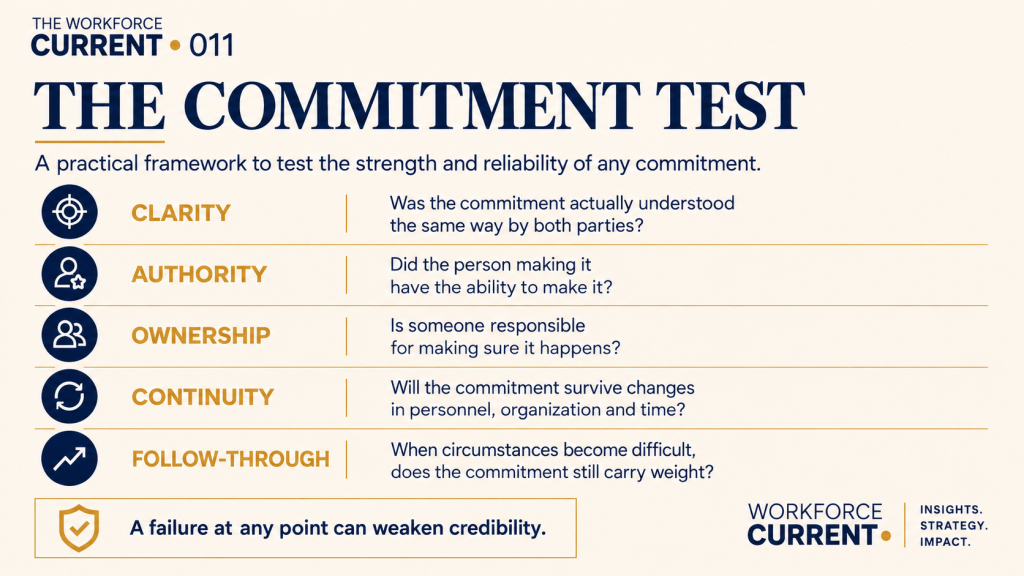
A failure at any point can weaken credibility.
A commitment that was never clear cannot reliably be honored. A commitment made without authority may be impossible to execute. A commitment without ownership can simply disappear. A commitment without continuity dies when people change.
And a commitment that survives only while convenient teaches the other party something important: Do not rely on the next one.
What Leaders Should Watch
The warning signs are usually visible before the relationship openly deteriorates. Listen for statements such as:
- “We’ve heard that before.”
- “Put it in writing.”
- “Who authorized that?”
- “That was the old management team.”
- “That isn’t what we agreed to.”
- “I’m not taking that back to my people unless I know it will stick.”
Each statement may be justified in a particular situation. The pattern matters more than the isolated comment.
When both sides routinely assume that representations require additional protection before they can be relied upon, the relationship is signaling a credibility problem.
And credibility problems compound.
A disputed commitment today changes the interpretation of tomorrow’s commitment. The institutional history gets updated.
The Executive Signal™
Executives should ask a question that is rarely found on a traditional labor-relations dashboard:
When our organization makes a commitment in the labor relationship, what makes it durable?
Then go deeper:
- Do the people making commitments have the necessary authority?
- Are consequential understandings captured accurately?
- Can important commitments survive leadership changes?
- Do supervisors know what prior commitments constrain their decisions?
- When circumstances change, do the parties revisit commitments directly—or simply behave as though they no longer exist?
- Has our history taught the other party that our word carries forward?
Because credibility cannot be declared. The other party decides whether you have it, based largely on what happened the last time relying on you mattered.
Executive Takeaway
Current ● 010 made the case that the bargaining environment is built before formal bargaining begins.
One of the things being built is credibility.
Not abstract trust. Not harmony. Not agreement on every issue. Credibility.
The practical expectation that a legitimate commitment will retain meaning after the immediate pressure of the conversation has passed.
That expectation changes how much information can move, how much flexibility is possible, how quickly problems can be resolved, how much formal protection each side believes it needs and what the parties eventually carry into the next difficult conversation.
The Workforce Current provides independent analysis and commentary on labor relations, workforce strategy, skilled trades and leadership. The views expressed are solely those of the author and do not represent any employer or organization.
NEXT CURRENT ● 012
TWO SIDES. TWO REALITIES.
What happens when management and labor see the same workplace differently?
Source Notes
- Federal Mediation and Conciliation Service. Relationships-by-Objectives. Current FMCS relationship-development fact sheet; supports the article’s discussion of mutual action planning, communication, relationship needs and declared commitment by labor and management. Source
- Federal Mediation and Conciliation Service. Labor-Management Committee Effectiveness. Current FMCS guidance; describes labor-management forums as collaborative, mutually committed, ongoing processes for addressing workplace problems directly. Source
- Federal Mediation and Conciliation Service. Preventative Mediation. Current FMCS service description; describes facilitation, consultation and training during the course of a contract to improve problem solving, bargaining, communication and relationships. Source
- International Labour Organization. ILO Helpdesk: Business and Collective Bargaining. States that effective good-faith collective bargaining includes respecting agreements concluded and applying them in good faith. Source
- International Labour Organization. The Application of Collective Agreements. Factsheet No. 4, 14 December 2015; addresses joint monitoring of agreement implementation and agreed procedures for resolving application problems. Source
