
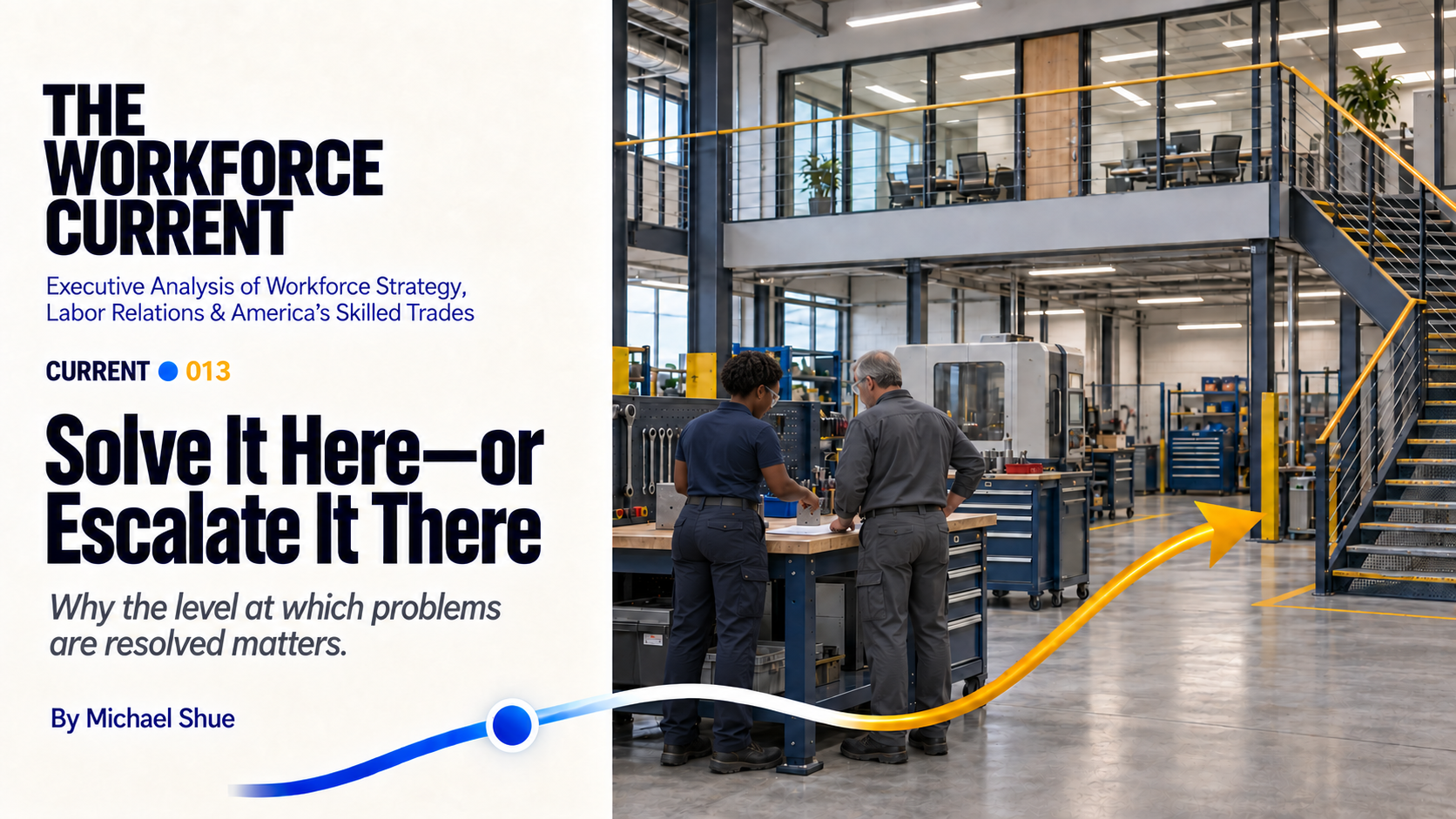
Why the level at which problems are resolved matters.
THE WORKFORCE CURRENT | By Michael Shue | CURRENT ● 013
Estimated reading time: 7 minutes
Executive Brief
- The problem: Unnecessary escalation consumes time and capacity and can turn a manageable issue into an institutional dispute.
- The implication: People closest to the work need the authority and capability to resolve the decisions they own.
- The action: Use the Travel Test to resolve locally, bring support to the issue, or escalate when authority, risk, contractual implications, or precedent require it.
The fastest way to make a small problem expensive is to send it too far up the organization.
A scheduling disagreement becomes a management issue.
A misunderstanding becomes a formal dispute.
A question that could have been answered in ten minutes moves through three levels of leadership.
By the time senior leaders see it, the original problem may no longer be the biggest problem.
Now there is history. Documentation. Positions to defend.
Organizations often treat escalation as a measure of problem severity. Sometimes it is.
But repeated escalation can reveal something else:
The organization has lost the ability to resolve ordinary problems where they occur.
Escalation Has a Cost
Every organization needs escalation.
Some issues involve safety, significant risk, policy, contractual obligations, or precedent. Others require authority that simply does not exist at the front line. Those issues should move.
The mistake is treating that movement as costless.
Every unnecessary escalation consumes organizational capacity.
More people become involved. More meetings are scheduled. More documentation is created. Response times lengthen. Positions become more formal.
What began as a local problem becomes institutional work.
That is The Escalation Tax™: the additional time, attention, friction, and organizational capacity consumed when a problem travels farther than necessary to reach resolution.
But the greater cost may be what happens to the problem itself.

Escalation Changes the Problem
Problems do not remain unchanged as they move through an organization.
At the point of origin: What happened, and how do we fix it?
One level higher: Who made the wrong decision?
Another level higher: What does the agreement or policy require?
Eventually: What precedent are we creating?
Each can be a legitimate question. But something important has happened.
The organization has moved from solving an event to managing its implications.
That changes incentives.
People begin protecting decisions. Language becomes more precise. Positions harden. Informal flexibility declines. The cost of changing position increases.
The farther an issue travels, the harder it can become for either side to say:
We misunderstood each other. Here is a reasonable solution.
Authority Determines Where Problems Go
Leaders often tell people to solve problems at the lowest possible level. That advice sounds right. It is also incomplete.
You cannot demand local problem-solving while centralizing the authority required to solve problems.
If frontline leaders need approval for every meaningful judgment, escalation is not a behavioral failure. It is the system working exactly as designed.
The same principle applies from the other side of the relationship.
When employees or their representatives conclude that local conversations rarely produce meaningful results, they eventually stop investing in them. They go where the authority is.
Over time, a pattern develops:

At that point, escalation stops being an exception. It becomes the operating model.
Senior leaders, labor leaders, and specialists begin resolving problems that should never have needed them.
That can look like control. It is often dependency.
The Travel Test™
The objective is not to keep every problem at the front line. Some problems should escalate quickly.
The discipline is determining how far an issue actually needs to travel.
Tiered escalation is not a new idea. What The Travel Test™ adds is a decision at every level: resolve it here, or move it only as far as its consequences require.

LEVEL 1 RESOLVE
The people closest to the issue have the information, authority, and relationship necessary to solve it.
Keep it there.
LEVEL 2 SUPPORT
Local ownership remains, but expertise, interpretation, or guidance is needed.
Bring expertise to the problem without automatically taking ownership of it.
LEVEL 3 ESCALATE
The issue exceeds local authority or creates meaningful organizational risk, contractual implications, or precedent.
Move the decision to the level capable of owning those consequences.
LEVEL 4 GOVERN
The implications extend beyond the original situation and require a broader organizational or labor-management decision.
Treat it as a system question, not simply a local dispute.
The Travel Test in Practice
Consider a hypothetical scenario: a routine schedule change.
The craft’s start time needs to move. The supervisor makes the call and informs the crew.
On the floor, it looks like a simple communication.
The contract sees it differently. When a shift change falls outside the established hours, it requires approval at the union business agent level.
The business office learns about the change after the fact. They are angry about not being included in the decision. They file a grievance.
Now the problem has moved.
It is no longer about a start time. It is about who had the authority to change it.
The grievance works its way through the process. By then, the new start time has already been implemented. The work is disrupted, and whatever the grievance decides will arrive well after the fact.
The company pays for it in reputation.
Run the Travel Test on this one and the answer is not “keep it local.” Once the change fell outside established hours, it exceeded the supervisor’s authority. It was a Level 3 decision made at Level 1.
The clean path was simple: pull the steward and the business agent into the discussion before deciding to change the established hours.
The Travel Test cuts both ways. Some problems travel too far. Others do not travel far enough, and end up traveling much farther because of it.
Move the problem only as far as necessary to resolve it responsibly.
That is different from minimizing escalation. Strong organizations do not minimize escalation. They minimize unnecessary escalation.
Watch the Pattern Not Just the Problem
One escalated issue tells leaders something about that issue. Repeated escalation tells them something about the system.
When the same categories of problems continually travel upward, the instinct is often to ask:
Why do people keep escalating these problems?
A better question is:
What prevents these problems from being resolved earlier?
Maybe authority is unclear. Maybe frontline capability is weak. Maybe trust has deteriorated. Maybe incentives reward escalation. Maybe previous attempts at local resolution went nowhere. Or maybe the issue genuinely belongs higher.
Those explanations require very different responses.
That is why escalation patterns are useful organizational data. They reveal where authority, capability, trust, and accountability may be misaligned.
Build Resolution Capacity
Effective systems do not merely establish escalation procedures. They build the capacity to resolve problems before escalation becomes necessary.
Frontline leaders understand the decisions they own.
Employees and their representatives understand where meaningful decisions can be made.
Specialists support the relationship without automatically absorbing local ownership.
Senior leaders resist becoming the default answer to problems that belong elsewhere.
And everyone understands when escalation is not only acceptable, but necessary.
That creates confidence in the system.
People learn that raising an issue locally is worthwhile because something can actually happen there. They also know there is a credible path upward when the consequences exceed local authority.
Both conditions matter.
A system with no escalation path traps problems. A system where everything escalates exports them.
The strongest organizations know the difference.
The Executive Signal™
Repeated escalation is not merely a workload issue. It is a signal that decision rights, capability, trust, or accountability may be misaligned. Leaders should examine the pattern before blaming the people who use the escalation path. Do not measure control by how many decisions reach senior leaders.
THE CURRENT PRINCIPLE
Solve problems as close to the work as capability and authority allow. Escalate when the consequences require it, not because the system has forgotten how to resolve them locally.

FREE EXECUTIVE RESOURCE
The Workforce Capability Diagnostic
Can your workforce execute your strategy?
Use this free 10-minute diagnostic to evaluate five dimensions of workforce capability and identify where development time could place strategy at risk.
Free. Ungated. Downloadable PDF.
NEXT CURRENT ● 014
CAN A LABOR AGREEMENT ADAPT?
The tension between stability and necessary change.
Put this issue to work
Review one recently escalated issue. Did it travel to the level its authority and consequences required, or did the system send it farther than necessary?
Continue reading
Two Sides. Two Realities.
Why management and labor can interpret the same workplace event differently—and how The Interpretation Chain™ helps leaders diagnose what is actually driving the dispute.
The Front Line is Where Strategy Becomes Real
Strategy does not create results on its own. Execution happens at the front line, where priorities become decisions, behaviors and performance. Current ● 009 examines the conditions leaders must create to turn enterprise strategy into operational reality.
Editorial Disclaimer
The Workforce Current provides independent analysis and commentary on labor relations, workforce strategy, skilled trades and leadership. The views expressed are solely those of the author and do not represent any employer or organization. Graphics were created with AI assistance using ChatGPT and reviewed and approved by the author.