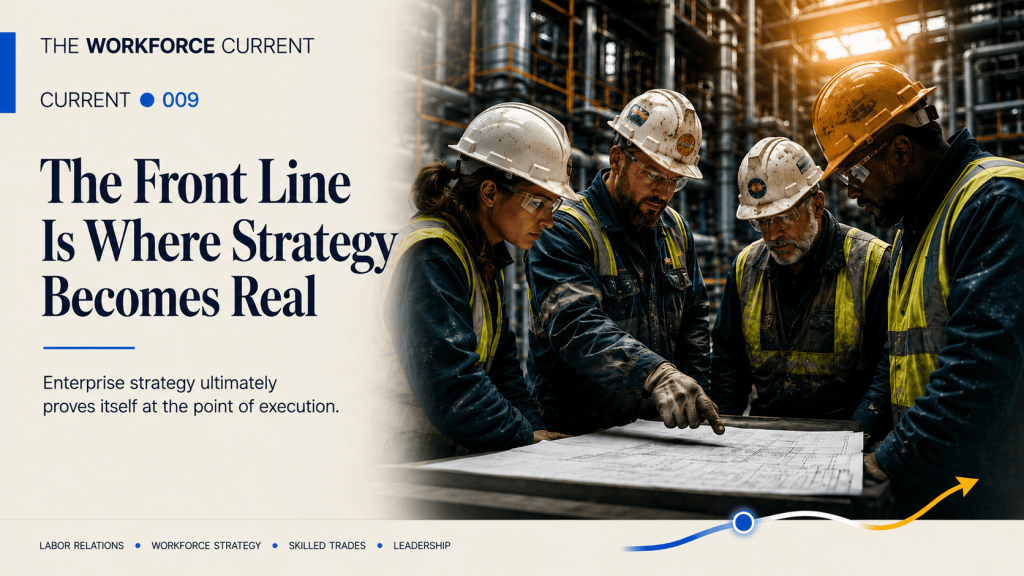
Enterprise strategy ultimately proves itself at the point of execution.
THE WORKFORCE CURRENT | By Michael Shue | CURRENT ● 009
EXECUTIVE BRIEF
Executives set direction.
Organizations allocate capital.
Leaders redesign operating models, introduce technology, establish priorities and define the outcomes the enterprise intends to achieve.
But none of those decisions creates results by itself.
Eventually, strategy reaches the front line.
It reaches the supervisor deciding how work will be organized.
The experienced employee interpreting a new process.
The crew balancing production, quality and safety.
The manager resolving competing priorities.
The technician adapting technology to conditions its designers may never have encountered.
That is where strategy stops being an idea.
It becomes work.
THE EXECUTION GAP
In the last two issues of The Workforce Current, we examined two constraints on enterprise execution.
Current ● 007 — The Capacity to Build argued that workforce capacity is more than headcount. Organizations need the right combination of people, skill, experience, mobility, supervision and timing.
Current ● 008 — Workforce at the Speed of Strategy extended that argument: strategy can change faster than capability can develop. Leaders therefore have to decide early what capability to build, buy, amplify, access through partners or sequence over time.
But even when the required capability exists, another problem remains. Capability must still be converted into execution.
That conversion happens largely through the operating layer closest to the work. A strategy understood in the boardroom but poorly translated on the front line is not fully implemented strategy.
It is intent.
STRATEGY HAS TO SURVIVE TRANSLATION
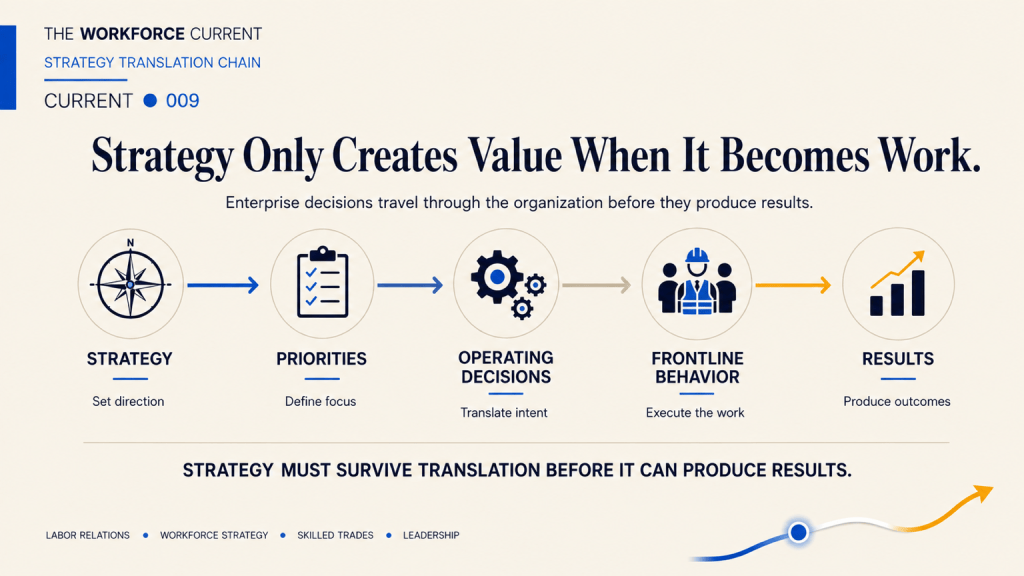
Enterprise decisions travel through an organization before they produce results. At each level, broad direction must become increasingly specific.
STRATEGY → PRIORITIES → OPERATING DECISIONS → FRONTLINE BEHAVIOR → RESULTS
Information does not move through this chain mechanically.
People interpret it. Managers prioritize it. Supervisors translate it. Workers encounter the real operating conditions in which it must function.
That creates the strategy-to-execution distance: the organizational distance between deciding what should happen and making it happen consistently at the point of work. The greater that distance, the more opportunities there are for priorities to become diluted, misunderstood or disconnected from operating reality.
The objective is not simply better communication.
It is better translation.
THE FRONTLINE SUPERVISOR IS AN EXECUTION NODE
Few roles sit closer to the intersection of enterprise strategy and operating reality than the frontline supervisor. The role is often described primarily in administrative terms: scheduling work, managing attendance, enforcing procedures and tracking performance. That understates its strategic importance.
Frontline leaders routinely translate organizational priorities into decisions about:
• how work is sequenced,
• where scarce skills are deployed,
• how new processes are adopted,
• when problems are escalated,
• how standards are reinforced,
• how competing priorities are reconciled,
• and how employees understand what matters.
Those decisions accumulate. Across an organization, they help determine whether enterprise priorities become operating behavior.
The scale of managerial influence is significant. Gallup reports that managers account for at least 70% of the variance in team-level employee engagement. Engagement is not the same thing as strategy execution, but the finding demonstrates how strongly the manager closest to the work can shape the conditions under which people perform.
That makes frontline leadership more than a people-management capability.
It is execution infrastructure.
The Workforce Capability Diagnostic helps leaders assess whether front-line expectations, supervisory capability and problem resolution support that translation.
THE REALITY FLOWS BOTH WAYS
Strategy cannot only travel downward. Operating intelligence must travel upward.
The people closest to the work often see emerging constraints before they become visible in executive metrics. They see where procedures collide with operating reality, where skills are becoming scarce, where technology creates friction and where assumptions no longer hold.
Organizations that treat the front line only as the destination of strategy lose part of that intelligence. The stronger model is a loop:
DIRECTION → TRANSLATION → EXECUTION → SIGNAL → ADAPTATION
Execution therefore becomes more than the final stage of strategy. It becomes an input to strategy.
THE EXECUTIVE QUESTION
When leaders approve a strategic initiative, the question should not end with: Do we have the capability to execute it?
It should continue: Can the organization translate this decision all the way to the point of work?
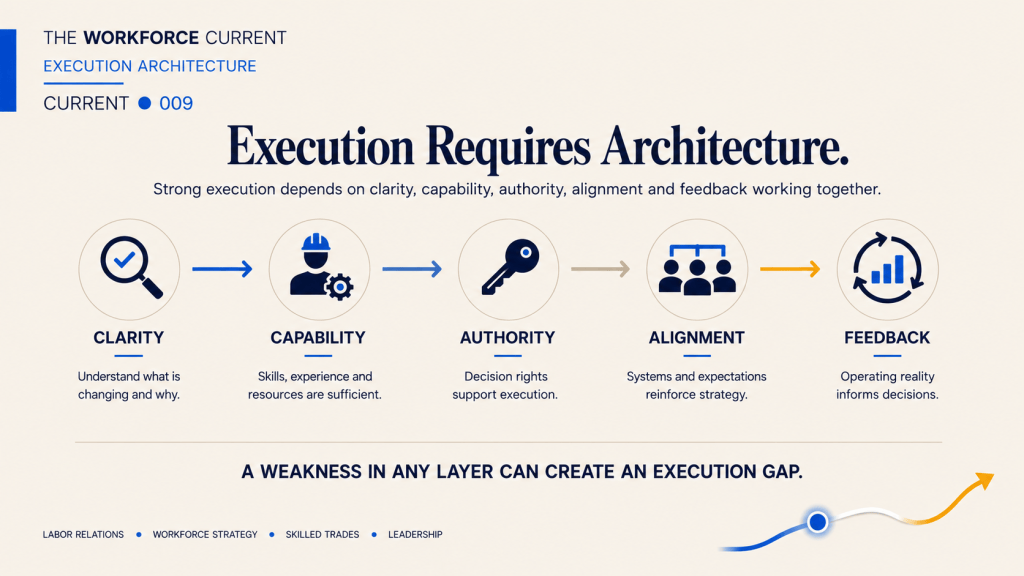
That requires examining five layers of execution:
CLARITY
Do frontline leaders understand what is changing and why?
CAPABILITY
Do the people performing the work have the required skills, experience and resources?
AUTHORITY
Can supervisors make the operating decisions necessary to execute?
ALIGNMENT
Do incentives, processes, staffing and performance expectations reinforce the strategy?
FEEDBACK
Can operating reality move back through the organization quickly enough to influence decisions?
A weakness in any one of these layers can create an execution gap even when the underlying strategy is sound.
THE FRONT LINE IS NOT THE END OF THE STRATEGY PROCESS
Organizations sometimes treat execution as what happens after strategy is finished. But execution is not separate from strategy. Execution tests strategy against reality.
A workforce plan may appear sufficient until the work begins. A technology deployment may look efficient until experienced operators encounter its limitations. An organizational structure may appear logical until decision rights collide with actual operating conditions. A schedule may look achievable until scarce expertise becomes the constraint.
The front line exposes those differences. The question for leaders is whether the enterprise can detect and respond to them before small execution gaps become large performance problems.
THE EXECUTIVE SIGNAL™
When strategy changes, examine the entire translation path—not merely the strategic decision.
Ask:
Who must understand it?
Who must translate it?
Who must execute it?
What operating conditions must support it?
What signals need to travel back?
Strategy does not create enterprise value when it is announced. It creates value when thousands of decisions and behaviors begin moving in the same direction.
THE PRINCIPLE
STRATEGY SETS DIRECTION.
CAPABILITY MAKES EXECUTION POSSIBLE.
THE FRONT LINE CONVERTS INTENT INTO RESULTS.
The organizations that execute well will shorten the strategy-to-execution distance between strategic intent and operating reality.
They will strengthen the leaders who translate direction into work and build systems that allow information to move in both directions.
Because ultimately:
THE FRONT LINE IS WHERE STRATEGY BECOMES REAL.
Source: Gallup, State of the Global Workplace: 2024 Report; Gallup workplace research on managers and team engagement.
FREE EXECUTIVE RESOURCE
The Workforce Capability Diagnostic
Can your workforce execute your strategy?
Use this free 10-minute diagnostic to evaluate five dimensions of workforce capability and identify where development time could place strategy at risk.
Free. Ungated. Downloadable PDF.
NEXT CURRENT
CURRENT ● 010
The Economics of Labor Relations
Labor relations is often discussed as a function of negotiations, contracts and disputes.
But its economic consequences extend much further.
Next: how labor relations can influence productivity, operating continuity, workforce stability and enterprise value.
The Workforce Current provides independent analysis and commentary on labor relations, workforce strategy, skilled trades and leadership. The views expressed are solely those of the author and do not represent any employer or organization.
